





A row of dark-sided single-story houses with shingled roofs behind trimmed hedges and mown lawn, framed by large leafy trees under an overcast sky.

Heat Pump Repair in Hastings, MI

Tell us about the job

Takes about a minute. No obligation.

RepairHeat PumpBarry County, MI
Step 1 of 2

What ZIP code is the job in?

Heat pump here runs October through May, about eight months straight. September is the slow month before that, worth a look before the real load starts. Most breakdowns in early fall trace back to something that was already weak and just getting by. A heat pump can limp along on a low charge or a tired part when it only has to run a little. Once it has to run most of the day to keep the house warm, that same weak spot is what gives out. That's usually the first cold stretch, not the dead of winter.

8 months
October through May, your system heats
3 months
June through August, it cools
19°F
the average winter night it heats against
81°F
the average summer afternoon it cools against
Isometric cutaway illustration of a small house showing interior ductwork and an air handler connected by lines to an outdoor condenser unit on a pad beside the building.
Your system heats October through May and cools June through August.

NOAA nClimDiv, 1991–2020 normals

Winters here are cold but the swings aren't extreme, averaging 19°F overnight through December, January and February.

A heat pump built for that doesn't get pushed past what it's made for, so most problems trace back to one weak part, not a system worn out from strain.

At 19.3 cents a kilowatt-hour, a heat pump running on a bad part is burning money every day you wait

Power costs 19.3 cents a kWh statewide
Climate zone 5A
Cooling runs June through August

A heat pump that's struggling doesn't trip a breaker or shut itself off. It just runs longer to make the same heat, and you keep paying for that extra runtime until someone finds the part that's failing. That's the cost of waiting on this one, not a repair bill you don't have yet. Get the actual cause found instead of letting the system cover for it another month.

This is a repair, not a rebuild

Homes in Barry County split about evenly between built in 1976 or earlier and built in 1976 or later. Neither age makes a heat pump act up more than the other. Whatever yours is doing has a specific cause, and finding it is a normal repair.

Find a contractor
A man in a dark long-sleeve shirt and tan work pants, seen from behind, climbs wooden porch steps toward a navy front door while carrying a canvas tool tote, with a potted flowering plant beside the entry.
A white mini-split heat pump outdoor unit mounted on a concrete pad beside a gray-sided house, surrounded by gravel and green shrubs.

The parts that work hardest are the parts to check first

A part that runs for months at a stretch shows its wear differently than one that only starts a few times a season. The reversing valve is a good example. It's what switches the system between heating and cooling, and every cycle it makes is a chance for it to stick or leak. A unit that short cycles, or blows air that's gone lukewarm, often points back to that valve rather than anything bigger. The outdoor coil is another. It sits through months of frost and defrost cycles, and if the defrost board starts failing, frost builds up on the coil until it can't pull heat from the air at all. Finding problems like these isn't about the system being overworked. It's about knowing which parts see the most action and checking those first.

A weak compressor gets weaker under load

A compressor that's starting to fail can still move refrigerant when the demand is light. Make it run flat out to hold the house at temperature and it's working past what that worn part can keep up with. Left alone, the problem doesn't stay the same size. It gets worse until the compressor seizes or the system can't produce heat at all.
A refrigerant leak doesn't hold still

A heat pump low on charge will still run. It just moves less heat for the same effort, and the compressor works harder to make up for what's missing. That extra strain is what turns a slow leak into a compressor problem, and a compressor failure takes the whole system down with it.

Before you call anyone, check the thermostat batteries and the setting itself. A thermostat that's lost power or slipped into the wrong mode will make a heat pump look dead when nothing mechanical is wrong. Next, look at the outdoor unit. If it's buried in ice or snow, that's worth clearing by hand, but frost that keeps coming back fast is a different problem and not something to keep knocking off yourself. Check the indoor filter too. A filter clogged with dust chokes airflow, and a heat pump starved for airflow will run long and still fall short of the set temperature. Walk around the house and check that no vents are closed or blocked by furniture. If the air coming out of the vents feels cool rather than warm, that's normal for a heat pump and not by itself a sign of trouble. Past that, if the system is still short cycling or not holding temperature, that's a job for someone with gauges and training, not a screwdriver.

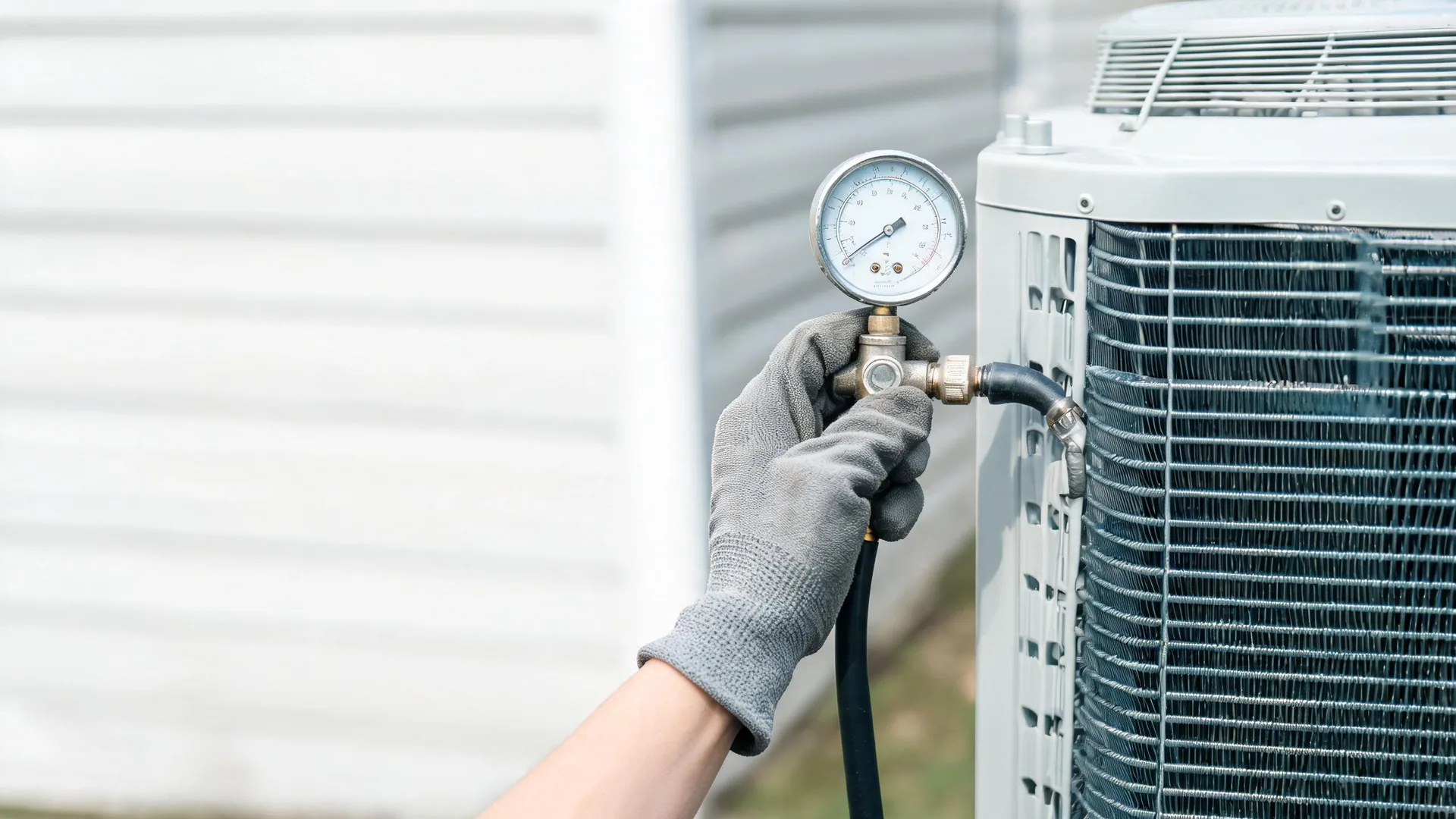
A diagnostic visit starts outside, with gauges on the service ports to check refrigerant pressure against what the system is supposed to hold. From there a tech checks amp draw on the compressor and the fan motors, because a motor pulling more current than it should is a motor working harder than it's built for. The reversing valve gets tested in both directions, not just the one the system happens to be stuck in. Defrost board and sensors get checked too, since a board that's misreading coil temperature will either over-defrost the unit or let frost pile up until the coil can't pull in heat. None of this is guesswork. Each reading rules something in or out, and the tech follows where the numbers point rather than swapping parts to see what helps.