







A nighttime view of a tree-lined residential street with illuminated two-story brick houses and street lamps.

Heat Pump Repair in Caro, MI

Tell us about the job

Takes about a minute. No obligation.

RepairHeat PumpTuscola County, MI
Step 1 of 2

What ZIP code is the job in?

Tuscola County has seen 87 severe weather events between 2015 and 2024, and most of them were damaging wind. A heat pump's outdoor unit sits right out in that weather with no wall to take the hit for it. Wind drives debris into the coil and fan, and hail dents the fins even when the unit keeps running afterward. A system that still blows air can have a damaged coil or a bent fan blade dragging on the motor. If your outdoor unit has been through a storm, it's worth having someone look it over, whether or not you've noticed a problem yet.

8 months
October through May, your system heats
3 months
June through August, it cools
18°F
the average winter night it heats against
80°F
the average summer afternoon it cools against
Isometric line illustration of a cutaway single-story house showing interior rooms, ceiling ductwork, an indoor air handler unit, and an outdoor condenser connected by a line set.
Your system heats October through May and cools June through August.

NOAA nClimDiv, 1991–2020 normals

Your heat pump switches over to heat in October here.

September is the month to get a weak unit looked at, before the first cold snap finds the part that storm damage left barely hanging on.

Winters here ask more of a heat pump than storms do

59 damaging wind events from 2015 to 2024
8 hail events from 2015 to 2024
14 winter storms from 2015 to 2024
A broken heat pump costs more hereMichigan electricity ran 19.30 cents per kilowatthour in 2024.

Half the homes in Tuscola County were built in 1971 or earlier. If your heat pump came with a house that old, it's probably not the original unit, but it may still be older than you think. Heat pumps run harder than straight AC since they work through the winter too, and that extra duty adds up over the years. A compressor nearing the end of its life can still run while costing more to keep going. Worth asking whoever looks at it how many years it likely has left before you put money into a big repair.

Had a storm come through? Get the outdoor unit checked before it has to work

If your outdoor unit has been through wind, hail or a storm this year, get it looked at now, even if it's still blowing air. A dented coil or a dragging fan blade won't show up as a problem until the unit is working hardest to keep up.

Find a contractor
A man seen from behind in a dark shirt and tan work pants carries a canvas tool bag up stone steps toward a gray panelled front door of a shingled house, with a potted shrub beside the entry.
A gray heat pump outdoor unit mounted on a concrete pad next to the stone-accented exterior wall of a house.

Ask how many years it has left

If a repair is on the table, ask how many years the compressor has left before you commit to it. A technician can check it and give you a straight answer. That matters more than whatever single repair is in front of you right now, since a unit near the end can need another one soon after.

The reversing valve is often the problem

A heat pump has one part straight AC doesn't have. The reversing valve lets it switch between heating and cooling. When it sticks, the unit keeps running but stays stuck in one mode, blowing cold air when you need heat. That's a common call, and it's a specific part a technician checks early, not a guess.
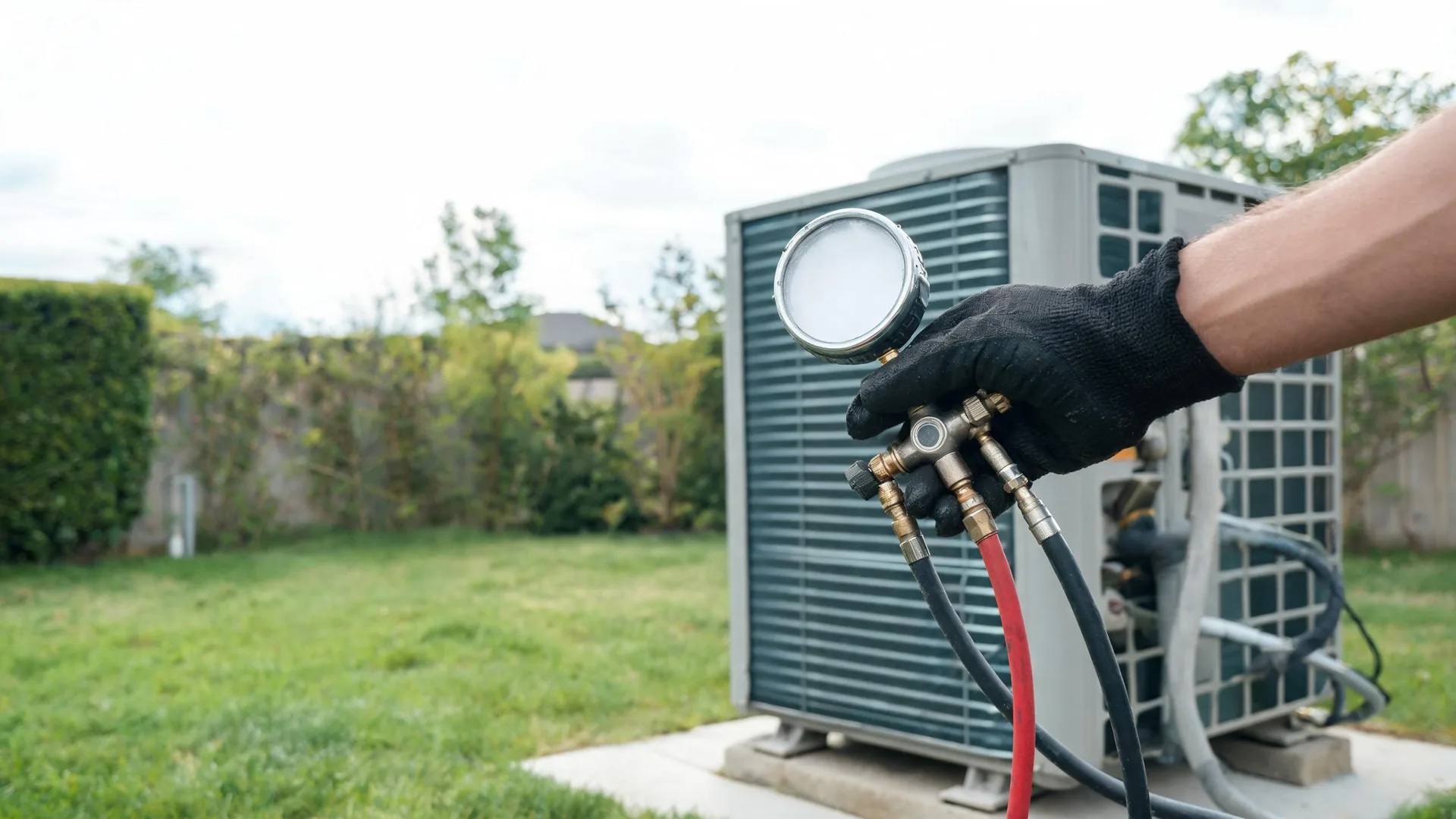
A failing capacitor shows up as short cycling

The capacitor gives the compressor and fan motors the jolt they need to start. When it weakens, the unit can struggle to start, run in short bursts, or hum without starting at all. It's a small part, and it's one of the more straightforward things to rule out before looking at anything bigger.

Before you call anyone, check the thermostat first. Make sure it's set to heat, not cool, and that the set temperature is actually above room temperature. Then look at the outdoor unit. If it's covered in ice or snow, that's worth noting but not alarming on its own, heat pumps frost up and defrost as part of normal operation. What's not normal is a solid block of ice that never clears, or a unit that's buried and can't pull in air at all. Check the indoor filter too, a clogged one chokes airflow and can make the whole system struggle. Last thing, check the breaker panel. A tripped breaker will shut the whole unit down and look a lot like a bigger failure when it isn't one.

A repair is worth it when the part failing is small on its own, a capacitor, a contactor, a fan motor, and the compressor still has good years left in it. Replacement starts to make more sense when the compressor itself is the problem. That's the part that actually moves refrigerant, and it's the most expensive thing in the unit by a wide margin. A compressor can keep running while worn, drawing more power and losing capacity, so the unit limps along instead of failing outright. If a technician tells you the compressor is weak, a repair somewhere else on the system is still money spent on a unit that's on its way out anyway. Ask directly whether the problem in front of you is isolated or a sign of what's coming next.