A row of dark-sided single-story houses with brown shingled roofs behind a tall trimmed hedge, surrounded by large leafy trees and mown grass under an overcast sky.

Furnace Repair in Kalamazoo, MI

Tell us about the job

Takes about a minute. No obligation.

RepairFurnace or heatingKalamazoo County, MI
Step 1 of 2

What ZIP code is the job in?

The heat exchanger decides the question

A furnace with a cracked heat exchanger is done, no matter what else on it still works. Everything else, the igniter, the blower motor, the flame sensor, the control board, can be swapped out on its own. The heat exchanger can't be patched safely, so if that's the part that failed, replacement isn't really a choice.

A furnace near the end acts up more than once

One repair on an older furnace doesn't tell you much by itself. A pattern does. If this is the second or third time a tech has been out for a different problem, the furnace is telling you it's worn down generally, not just in the one spot that broke this time. That's worth weighing before paying for another repair on the same unit.

8 months
October through May, your furnace is on duty
19°F
the average winter night it heats against
73%
of homes here heat with gas, so most furnaces here burn gas
15 winter storms
in ten years, the nights a failure hurts most
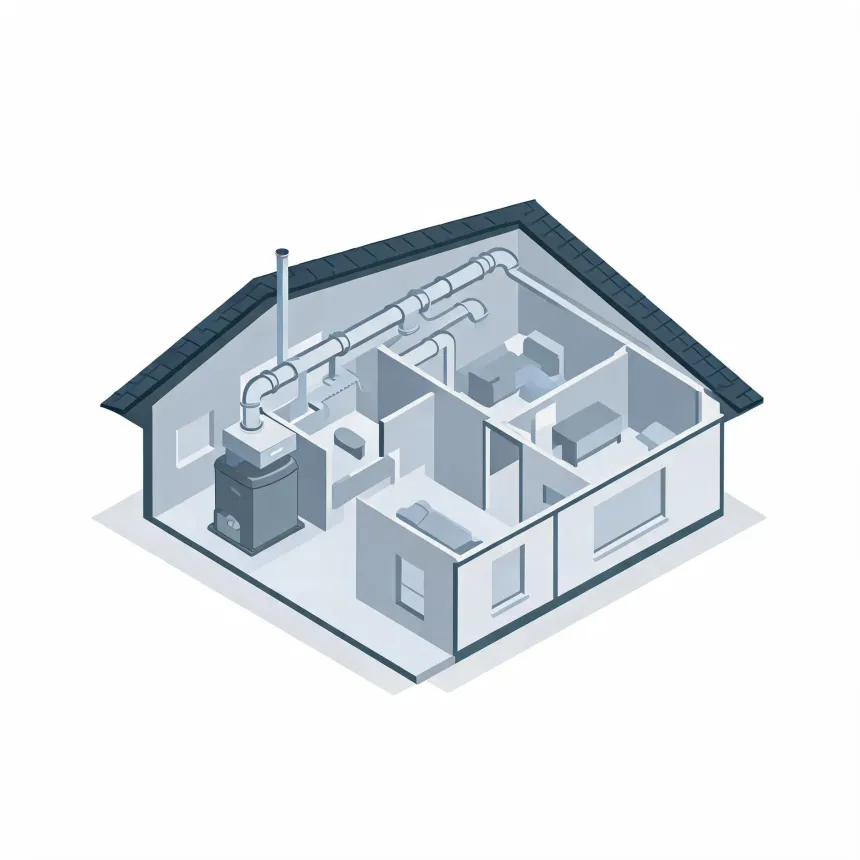
Isometric cutaway illustration of a single-story house showing interior rooms, ductwork running along the ceiling, a flue pipe through the roof, and a dark furnace unit in one corner.
Your furnace works hardest from November through March.

NOAA nClimDiv, 1991–2020 normals

A cracked igniter or a dirty flame sensor will make a furnace short cycle instead of shutting down clean.

Letting it keep trying to light puts more strain on the blower motor and the control board, so a small part failure turns into a bigger bill.

Eight months of heat a year wears a furnace down faster

Heat runs October through May
Winter nights average 19°F
Climate zone 5A
October starts the season hereFurnaces in Kalamazoo County run from October through May, and trouble usually shows up in the first cold weeks.

Eight months of heat a year means the furnace in your house is running a lot more than one in most parts of the country gets run. That kind of schedule doesn't leave much downtime for small wear to stay small. A tech who's just told to fix the one symptom you called about might clear the error and send you on your way without ever checking whether the real cause is upstream of it. Ask for the diagnosis before the repair. Have them tell you what actually failed and why, not just which part they're replacing. On a furnace that runs this much of the year, that's the difference between a fix that holds and one you're paying for again in a few months.

Get it diagnosed properly

Your furnace works hard here, and that's usually what's behind the problem. Have it diagnosed properly so the fix lasts.

Find a contractor
A gas furnace with attached ductwork, gas piping, and condensate lines installed in a concrete-block basement.

Most failures start small and get found late

Furnaces usually fail for one of a few reasons. Age wears out ignition parts first, the igniter or the flame sensor, since those take heat and flame exposure every single cycle. Dust and neglect come next. A dirty filter chokes airflow, the blower works harder to push air through, and the heat exchanger runs hotter than it should, which shortens its life. Thermostats and control boards fail less often but cause the most confusing symptoms, since a bad board can mimic a dozen other problems. Ductwork and venting issues sit underneath a lot of repeat calls too. If air isn't moving the way the system expects, something downstream pays for it, usually the blower motor or the exchanger. None of these causes announce themselves clearly. That's why the symptom you notice, no heat, a strange smell, short cycling, often points at the wrong part if nobody traces it back to where the wear actually started.

What's safe to check yourself

Check the thermostat is set to heat and the temperature is actually above room temperature. Look at the furnace door and make sure it's closed all the way, since most furnaces have a safety switch that won't let it run with the door off or loose. Check the air filter and swap it if it's gray or caked with dust. Go to the breaker panel and look for a tripped breaker, and check that the switch on or near the furnace, the one that looks like a light switch, hasn't been bumped off.

Where to stop and call someone

If the pilot or igniter won't catch after a couple of tries, stop resetting it and get a tech out instead of repeating the cycle. The same goes for any burning smell that doesn't fade after the first few minutes of a cold start, a furnace that smells like gas at any point, or a carbon monoxide alarm going off. Those aren't things to keep testing on your own. Once the basics check out and it's still not running right, the problem is inside the furnace, not something a homeowner can safely chase further.

An unfinished basement containing a forced-air furnace with metal ductwork, exposed wooden ceiling joists, a hanging Edison bulb, and bare concrete floors.

A new furnace would cut about $140 a year off heating for a typical Kalamazoo County home.

  • A new high-efficiency furnace$580 a year
  • An older furnace$720 a year

Estimates for a typical Kalamazoo County home, compared with an older unit built to the previous federal minimum, from EIA household energy data, Michigan fuel prices and NOAA climate normals. Your home will differ.

Repair makes sense when one part has failed and the heat exchanger is sound.

Replacement makes sense when the heat exchanger is cracked or the furnace keeps needing parts.

A diagnostic visit starts before any panel comes off. A tech asks what the furnace was doing right before it failed, since a smell, a sound, or a particular point in the cycle narrows things down fast. Then the panel comes off and they check for power at the board, check the flame sensor reading, and watch a full cycle from ignition through shutdown if the furnace will run at all. Pulling a part and testing it on the bench tells you whether that part is actually bad, instead of guessing from the symptom alone. A short cycling furnace, for instance, can look like a sensor problem when the real cause is a pressure switch not satisfying because of a blocked vent. The visit ends with the tech telling you which part failed and why it failed, not just which part they're planning to swap.