





An unfinished basement interior featuring a large metal furnace unit, exposed ceiling joists, concrete walls, and scattered boxes and cables on the floor.

Furnace Maintenance in Mount Pleasant, MI

Tell us about the job

Takes about a minute. No obligation.

Tune-up, service, or cleaningFurnace or heatingIsabella County, MI
Step 1 of 2

What ZIP code is the job in?

Isabella County logged 31 severe weather events between 2015 and 2024. Most of that was wind, 18 events, with winter storms close behind at 10. A furnace tune-up usually means checking the burner, the igniter, the flame sensor, and the vent, but if your furnace shares a system with central air, the outdoor unit sits outside through all of it. Wind-blown branches and debris get into the fins. Hail dents the housing. None of that shows up as a problem until the system is running hard and can't. A tune-up before the weather turns is the time to find it.

Half the homes in Isabella County were built in 1983 or later.

A furnace that age still has years in it, and a yearly check is what gets it there.

Nine months of heat start in September. Have it looked at in August.

Heat runs September through May
Climate zone 6A
Winter nights average 17°F
Nine Months of Work a YearFurnace here runs nine months a year, September through May.

Just over half the homes here heat with gas, and most of the rest run on propane. Both burn a flame inside a sealed chamber, and that chamber has to vent to the outside correctly every time it fires. A tune-up on one of these furnaces means checking the burner, the flame sensor, and the venting, not just swapping a filter. A cracked heat exchanger or a vent pulling wrong is not something you can see from across the room. Electric furnaces, the other sizable share here, skip the combustion side entirely, but gas and propane units need that check done every year.

Have the outdoor unit checked before the weather turns

The outdoor unit sits through wind, hail, and snow all year. A tune-up now is when a bent fin or a nest of debris in the coil gets found and cleared, before the system has to run hard against the next storm.

Find a contractor
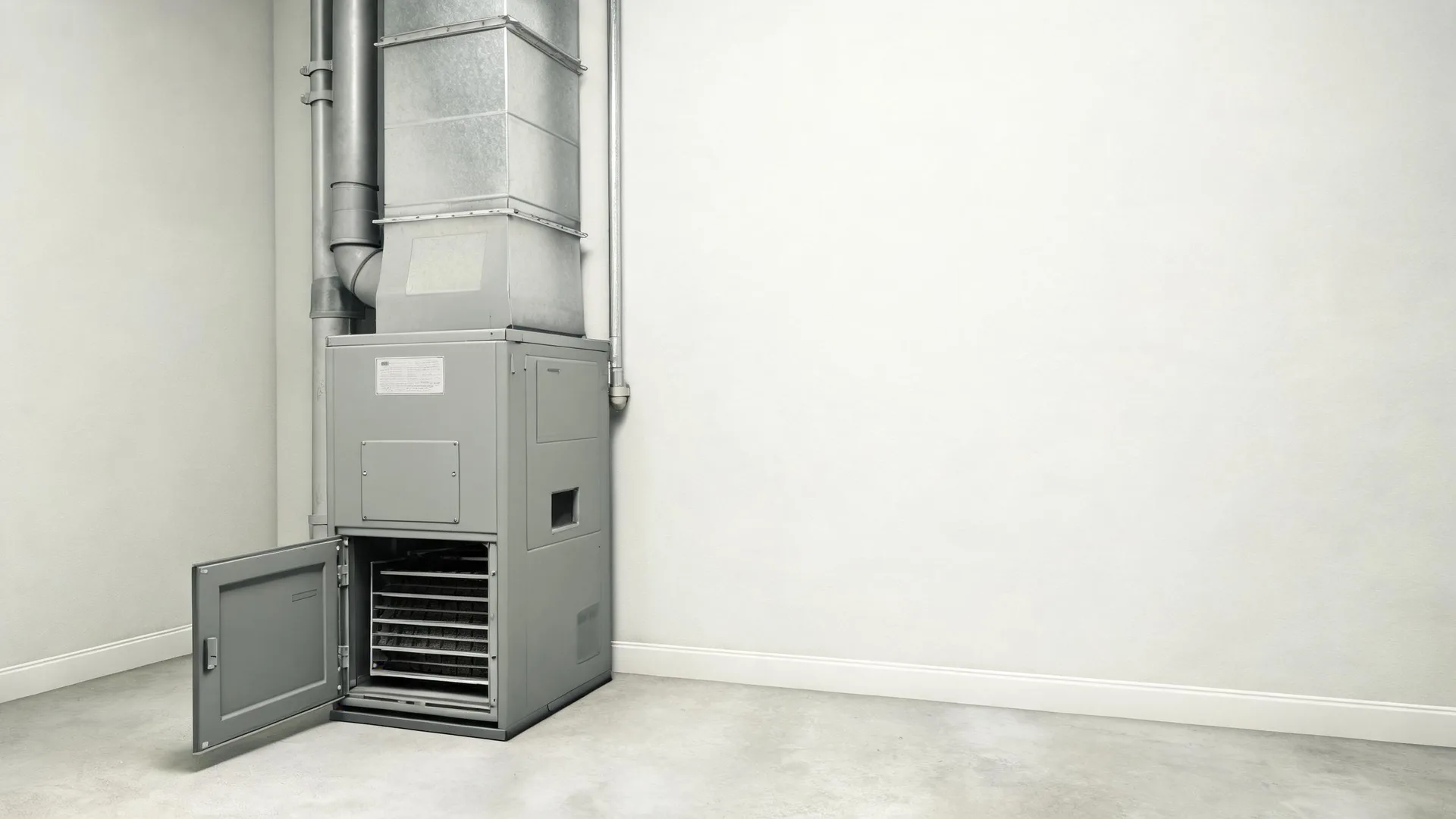
A gray high-efficiency gas furnace installed in an unfinished basement, surrounded by gas lines, a condensate drain, and sheet-metal ductwork.

Idle Now, Working Soon

Nine months is most of the year. Once the furnace starts in September, it doesn't get a break until spring, and whatever is wrong with it by then runs wrong for the whole stretch. A worn igniter or a flame sensor going bad doesn't wait for a good time to fail. Get it looked at while it's sitting idle, not after it's already carrying the house through a cold stretch.

The Filter Is the Easy Part

A dirty filter chokes airflow across the heat exchanger. The blower has to push harder to move the same air, and the motor wears faster for it. Past a certain point, the exchanger overheats and trips the limit switch, shutting the furnace down mid-cycle. Checking the filter takes a minute. Most people just forget to.
The Drain Line Only Matters on Some Furnaces

High-efficiency furnaces pull extra heat out of the exhaust and condense it into water, and that water has to drain somewhere. The line it runs through is narrow, and condensate carries enough sediment to clog it over time. A clogged drain backs up into the unit and the furnace locks out rather than risk water hitting parts it shouldn't. A standard furnace that vents hot exhaust straight out doesn't have this line at all, so there's nothing there to check.

A quick tune-up means someone swaps the filter, glances at the burner flame, and packs up. A thorough one means the panels come off. The flame sensor gets cleaned or tested, not just looked at, because a sensor coated in oxidation reads fine by eye and still fails to hold a signal. The igniter gets checked for hairline cracks, the kind that only show up as a no-start on the coldest morning of the year. Someone checks amp draw on the blower motor, because a motor pulling more current than it should is wearing out even if it still spins fine today. The vent gets inspected for the right pitch and a solid connection, not just a look to confirm it's attached. If the technician is in and out in a few minutes with the furnace never apart, that's a filter change, not a tune-up.

A furnace that never gets opened up still runs, right up until the part that was quietly failing finally gives out. Dust and lint build up on the burner over time, and a burner that isn't burning clean can't heat efficiently even if the flame still looks fine. A flame sensor coated in oxidation will eventually stop holding a signal at all, and when it does, the furnace shuts itself down as a safety measure rather than run with a flame it can't confirm. That failure doesn't announce itself in advance. It shows up as a furnace that won't start, usually on the morning it's needed most. A cracked heat exchanger is worse, because it can leak combustion byproducts into the air the blower is moving through the house, and there's no way to see a hairline crack without the panels off. None of this is dramatic while it's building. It just sits there until the day it isn't sitting there anymore.