A row of dark-sided houses with brown shingled roofs behind trimmed hedges, lawn, and large deciduous trees under an overcast sky.

Heat Pump Repair in Lansing, MI

Tell us about the job

Takes about a minute. No obligation.

RepairHeat PumpIngham County, MI
Step 1 of 2

What ZIP code is the job in?

September is when a weak heat pump shows itself

Heat in Ingham County starts in October, and the first cold mornings push a heat pump harder than it's run in months. A compressor or a reversing valve that was already marginal tends to fail right when you switch over from cooling, not partway through winter.


Getting it looked at before October pays off

A heat pump with a problem in September still has a few mild weeks before the real cold sets in. That's time enough to get a contractor out, find out what's wrong, and get it fixed before the house actually needs the heat to work.

8 months
October through May, your system heats
3 months
June through August, it cools
19°F
the average winter night it heats against
80°F
the average summer afternoon it cools against
Isometric line illustration of a cutaway house showing interior rooms with furniture, ceiling ductwork connected to an indoor air handler, and refrigerant lines running to an outdoor condenser unit on a pad.
Your system heats October through May and cools June through August.

NOAA nClimDiv, 1991–2020 normals

A heat pump that hums but doesn't blow warm air is usually stuck in defrost or losing refrigerant.

Either one gets worse on its own, so don't wait out a mild week hoping it resets itself.

Half the homes in Ingham County are older than your heat pump's manual probably assumes

Half the homes here were built by 1971
Climate zone 5A
Power costs 19.3 cents a kWh statewide

Ingham County gets its share of rough weather, 44 severe events over the last ten years between wind, hail, a tornado and winter storms. That's nothing out of the ordinary for mid-Michigan, and it's not what's wrong with your heat pump. A tree limb or a power blink can trip a unit offline, but once power's back most heat pumps come back on by themselves. If yours didn't restart clean, or it's been struggling since well before the last storm, the cause is more likely a part that's worn out or a refrigerant charge that's been low for a while. That's the thing worth finding before the cold settles in.

A heat pump that's struggling costs more here every month it runs that way

Michigan power ran 19.30 cents per kilowatt-hour in 2024, and a heat pump working harder than it should is pulling more of it. That cost doesn't stop on its own. Get a contractor out to find the real problem before the cold settles in.

Find a contractor
A gray heat pump outdoor unit mounted on a concrete pad next to the stone-accented exterior wall of a house.

This climate doesn't push a heat pump that hard

Heat pumps here spend more hours heating than cooling. Ingham County is zone 5A, a cool climate where the heating load carries the year, and winter nights average 19°F. That's steady, moderate work, not the kind of extreme heat that pushes a system hard in the Southwest or the kind of brutal cold that strains one in the far north. A heat pump running in this climate for a handful of years hasn't been worked especially hard. If yours is struggling now, age or a worn part is the more likely reason, and that's usually worth fixing rather than replacing.

Most failures trace to the reversing valve or the capacitor

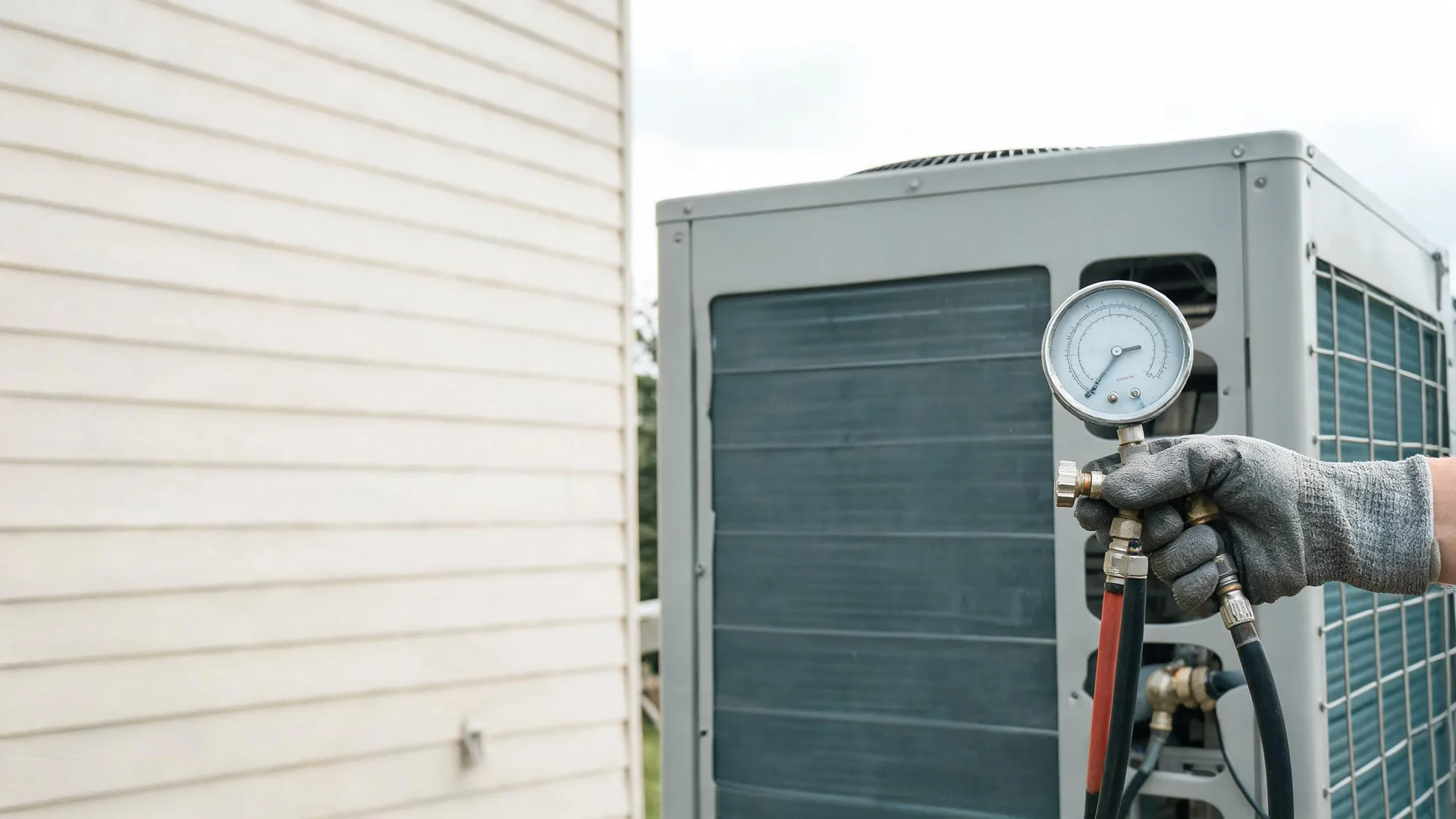
The reversing valve is what lets a heat pump switch between heating and cooling, and it's often the first part to stick or fail, usually leaving the system stuck blowing cold air during heating mode. A failing run capacitor is the other common cause, and it tends to show up as a unit that struggles to start or shuts off on its own partway through a cycle.

Low refrigerant rarely announces itself

A slow leak at a line fitting or coil can go unnoticed for a long stretch because the system still runs, just weaker, and still moves some warm air. The outdoor coil icing over more than it should, or the house never quite reaching the set temperature, are usually the first real signs something's been leaking for a while.

A heat pump that's low on refrigerant doesn't stay at the same level of low. The compressor still runs, still tries to move heat, and with less refrigerant to carry the load it works harder and runs hotter than it was built to. That heat has nowhere good to go. Over time it breaks down the oil that lubricates the compressor, and a compressor running dry wears out a lot faster than one that isn't. The same goes for a reversing valve stuck halfway, the system keeps cycling, keeps trying to switch, and the strain on the valve and the compressor both adds up each time it runs. None of that resets when the unit shuts off for the night. It picks up again next cycle, a little worse than before.

A diagnostic visit starts outside at the unit itself. A tech checks the refrigerant pressure, looks at the compressor and reversing valve, and watches how the system responds when it's told to switch between heating and cooling. Electrical readings come next, the capacitor and the contactor, since a weak capacitor often looks like other problems until it's tested directly. Airflow gets checked too, because a coil that's icing over or a blower not pulling its weight can mimic a refrigerant problem without being one. The point of the visit isn't to replace parts on a guess, it's to find the one thing actually failing before it takes the rest of the system down with it.