




A dark two-story house with a covered porch stands behind a hedge and large deciduous trees, viewed from a low angle across a mowed lawn under an overcast sky.

Heat Pump Repair in Jackson, MI

Tell us about the job

Takes about a minute. No obligation.

RepairHeat PumpJackson County, MI
Step 1 of 2

What ZIP code is the job in?

June and October are when heat pumps in Jackson County earn their keep. The system has been sitting idle, or barely working, for weeks before that first real demand hits it in May or September. A capacitor that was already weak often holds on until the compressor leans on it again, then it fails right at the start of the run. If your heat pump is struggling now, that timing isn't a coincidence. Getting it checked at the start of the season, instead of a few weeks in, means the fix happens before you're relying on the system every day.

8 months
October through May, your system heats
3 months
June through August, it cools
19°F
the average winter night it heats against
80°F
the average summer afternoon it cools against
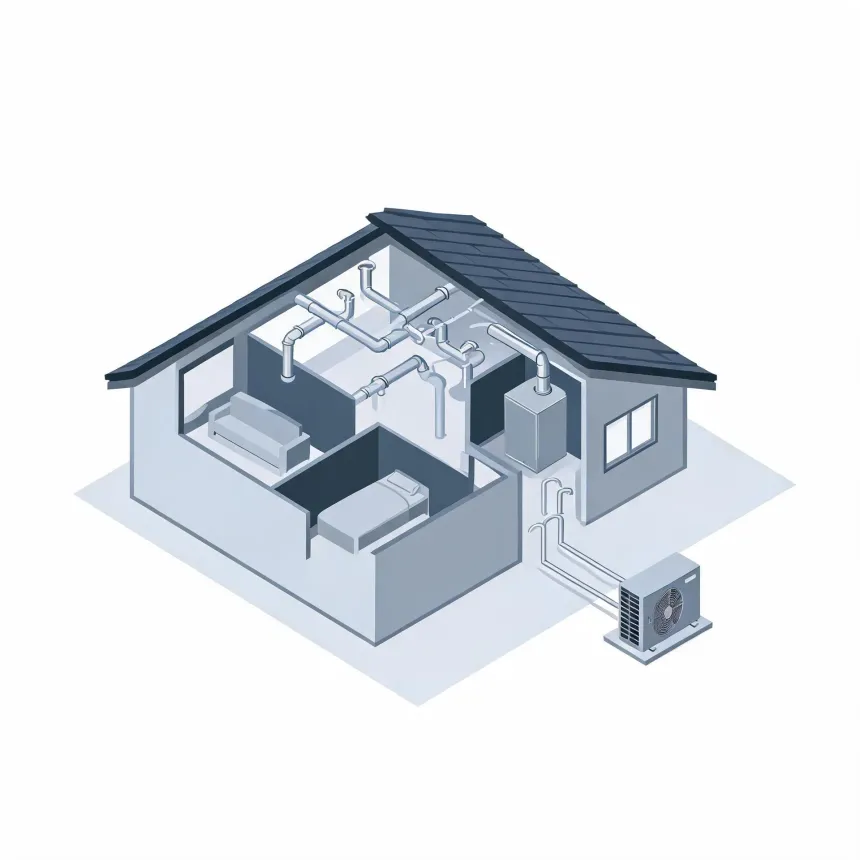
Isometric cutaway illustration of a small house showing ducted air distribution, an indoor air handler, and an outdoor condenser unit connected by lines, with a sofa and bed in the rooms.
Your system heats October through May and cools June through August.

NOAA nClimDiv, 1991–2020 normals

Jackson County winters average 19°F overnight, and that's the load a heat pump here is built around.

A heat pump working within the range it's designed for is usually a good candidate for repair instead of replacement.

Half the homes in Jackson County are old enough that their heat pump isn't the first one

Half the homes here were built by 1967
31 damaging wind events from 2015 to 2024
13 winter storms from 2015 to 2024

Jackson County has logged 48 severe weather events between 2015 and 2024, most of it wind. None of that points to your heat pump specifically. Wind and winter storms knock out power, and a heat pump that loses power mid-cycle can trip a breaker or need a reset once power is back, but that's true of this machine anywhere it's installed. If yours has been acting up, the weather here isn't the reason. Something in the system is the reason, and that's what a tech needs to find.

A heat pump that's struggling costs more to run here

Michigan electricity ran 19.30 cents per kilowatthour in 2024, on the higher side for this part of the country. A heat pump working harder than it should, short cycling or leaning on backup heat, pulls more power every day it goes unfixed. Getting the actual cause found now keeps that cost from stacking up through the season.

Find a contractor
A gray heat pump outdoor unit mounted on a concrete pad next to a residential house with lap siding and stone accents.

A system built for this cold, not pushed past it

Your heat pump isn't fighting deep cold here the way units do further north. Overnight lows average 19°F through the winter, well within what these systems are built to handle, so a unit that's acting up probably isn't being asked to do something unreasonable. That points away from replacement and toward repair. When a tech works on yours, the job is finding what's actually wrong, whether that's a stuck reversing valve, a low charge, or a control board issue, and fixing that part rather than writing off the whole system.

The reversing valve is usually the first thing to go

The reversing valve switches a heat pump between heating and cooling, and it moves every time the system changes mode. A valve that's stuck will leave you with heat when you want cooling, or cold air blowing during a heating cycle. Sometimes you can hear it, a clicking or a hum at the moment it should switch and doesn't.

The defrost cycle hides problems until they're not small anymore

In cold weather the outdoor coil frosts over, and the system is built to sense that and run a defrost cycle to clear it. If the sensor that reads coil temperature drifts, or the control board stops calling for defrost on schedule, ice builds up on the coil instead of melting off. A coil that stays iced loses the ability to pull in heat, and the system ends up leaning on backup heat to keep up.

Before you call anyone, go outside and look at the outdoor unit. Ice on the coil during a defrost cycle is normal, but a unit that's solid white or has ice built up an hour after it last ran is not clearing like it should. Check that nothing is blocking airflow around it, leaves, snow piled against the side, anything pressed up against the coil. Inside, check your thermostat is actually calling for heat or cooling and the batteries aren't dead, since a thermostat that's lost power can make a working system look broken. Look at your breaker panel too. A heat pump that tripped its breaker will act dead even though nothing inside it failed. If the breaker's fine and the thermostat's responding but the air coming out feels wrong for the mode you're in, that's a sign for a tech, not something to keep testing yourself.

A heat pump has a lot of parts that fail on their own without taking the rest of the system down with them. A reversing valve, a capacitor, a control board, these get replaced individually all the time, and doing that is usually the right call even on a unit that's been in service a while. A compressor is a different question. It's the most expensive part in the system, and when it's failing the repair can start to cost enough that putting that money toward a new system makes more sense. The other thing worth asking is how often this unit has needed a tech out. One failure is a repair. The same system needing attention every season is telling you something about where it's headed, and a tech who's seen it more than once is in a better position to say which situation you're in.