




Low-angle view across a mown green lawn toward a dark-sided building at left and a cream-colored single-story house with trees in the background under an overcast sky.

Heat Pump Repair in Coldwater, MI

Tell us about the job

Takes about a minute. No obligation.

RepairHeat PumpBranch County, MI
Step 1 of 2

What ZIP code is the job in?

A heat pump that's struggling still tries to do its job, and that's what causes the damage. Low refrigerant charge makes the compressor work harder to move heat, and it can overheat from the strain. A failing capacitor makes the fan motor pull more current than it should, which wears down the windings until the motor seizes. Ice on the outdoor coil blocks airflow, and running the unit through that ice forces the compressor to push against a system that can't breathe. In every one of these cases, the part that's already weak is the part that fails completely if the system keeps cycling. Shutting it down and calling for a look gives a technician a repair to make. Letting it run through the problem can turn that repair into a compressor or motor replacement.

8 months
October through May, your system heats
3 months
June through August, it cools
19°F
the average winter night it heats against
81°F
the average summer afternoon it cools against
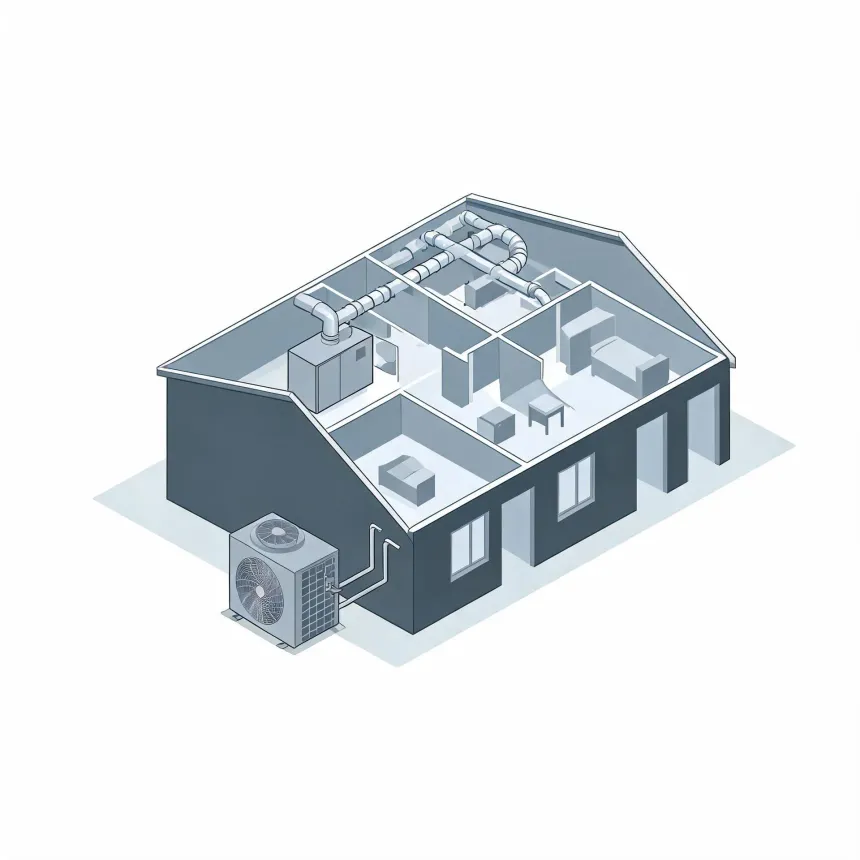
Isometric cutaway illustration of a single-story house showing interior rooms, attic ductwork and an air handler, with an outdoor condenser unit connected by lines along the exterior wall.
Your system heats October through May and cools June through August.

NOAA nClimDiv, 1991–2020 normals

Michigan electricity ran 19.30 cents per kilowatthour in 2024.

A heat pump that's straining to heat or cool your house burns through that rate faster every day you leave it running.

Half the homes in Branch County date to 1969 or earlier, and a heat pump installed with the house is well past the age where parts wear out.

Half the homes here were built by 1969
47 damaging wind events from 2015 to 2024
15 winter storms from 2015 to 2024

Branch County sits in a cool climate zone where heating carries most of the load, and the overnight low averages 19°F across December, January and February. That's a steady demand, not an extreme one, and a heat pump built for this zone is sized to handle it without strain. Wind and winter storms are what test the system here more than the cold itself. A heat pump that hasn't been run hard by the climate usually still has its original parts in decent shape. When something does act up, a repair is more often enough to put it right.

September is the month to get your heat pump checked before it switches to heat

October is close, and that's when your heat pump switches over to carrying the heat instead of the air conditioning. Whatever was already weak tends to show up in those first cold mornings, when the system has to push harder than it has all year. Getting it looked at in September, before that switch, means a technician can catch a weak part at a repair instead of a breakdown.

Find a contractor
A man in a dark cap, dark jacket and tan pants walks up gray porch steps toward a dark front door, carrying a worn brown leather duffel bag, with a potted shrub at left.
A white mini-split heat pump outdoor unit mounted on a concrete pad beside a gray-sided house, surrounded by gravel and green shrubs.

Ask what the repair buys you before you pay for it

If a heat pump this old starts acting up, that's worth a straight answer before any money goes into it. A technician can check what's actually worn versus what's still sound, and tell you whether a repair buys a season or two or whether you'd be putting a new part into an old box. Ask for that before you agree to a big repair.

What you can check safely

Look at the outdoor unit and see if it's caked in ice or buried in leaves and debris. Check the thermostat batteries and make sure it's set to the mode you want, since a setting bumped to the wrong mode will make the system act like it's broken when it isn't. Check your breaker panel for a tripped breaker. Look at the indoor filter and swap it if it's gray and clogged, since restricted airflow is behind a lot of the complaints that bring a tech out.
What to leave alone

Don't take panels off the outdoor unit or touch anything inside it. The refrigerant lines, the compressor and the wiring are not something to poke at, and opening the cabinet on a system that's still under warranty can void it. If you see ice on the coil, turn the system off and let it thaw rather than chipping at it. Flip the breaker off before you leave it alone for a tech to look at, so it isn't cycling against whatever's wrong while you wait.

A heat pump that needs a look usually tells you before it quits outright. Air coming from the vents that feels cooler than it should in heating mode is often the first sign, since a heat pump's air is naturally milder than a furnace's but it shouldn't feel like nothing at all. Listen for the system running long stretches without ever shutting off, or short-cycling on and off every few minutes, both of which point to something making the system work against itself. A hissing sound near the outdoor unit can mean a refrigerant leak, and that's worth shutting the system down for rather than waiting out. Ice building up on the outdoor coil that doesn't clear during the defrost cycle means that cycle isn't doing its job. And if the outdoor fan is running but the compressor sounds like it's straining or humming without starting, that's a part already failing, not a fluke.

The compressor is the part that costs real money. It's sealed, it isn't built to be opened, and if it fails the usual move is to replace the outdoor unit rather than the compressor itself. Everything else on a heat pump is built to be swapped on its own without touching the compressor at all. A capacitor, a contactor, a defrost sensor, a control board, these fail on their own and get replaced on their own, and the rest of the system doesn't care how old it is when that happens. So the real question isn't how old the unit is. It's which part gave out. A worn capacitor is a repair no matter the age of the system. A seized or failing compressor is a different conversation, and that one is worth having straight before any money goes into it.