





A nighttime view of a tree-lined residential street with illuminated two-story brick houses and street lamps.

Heat Pump Installation in Warren, MI

Tell us about the job

Takes about a minute. No obligation.

New system or replacementHeat PumpMacomb County, MI
Step 1 of 2

What ZIP code is the job in?

Macomb County saw 142 severe weather events between 2015 and 2024. Most of that was wind, 99 events, with 26 hail events and a tornado in the same stretch. Hail dents an outdoor unit's cabinet and can bend the fins on the coil. Wind throws branches and debris into it. Statewide, 34% of households lost power for a day or more in 2024, and a heat pump does nothing for you when the power's out, same as a furnace with no electricity to run its blower. Where the unit sits and what stands between it and the next storm is worth thinking about before it goes in the ground.

8 months
October through May, your system heats
3 months
June through August, it cools
21°F
the average winter night it heats against
81°F
the average summer afternoon it cools against
Isometric line illustration of a cutaway single-story house showing interior rooms, ceiling ductwork, an indoor air handler unit, and an outdoor condenser connected by a line set.
Your system heats October through May and cools June through August.

NOAA nClimDiv, 1991–2020 normals

Electricity here runs 20.25 cents a kilowatt-hour, higher than most of the country.

A heat pump that holds its efficiency keeps that rate from showing up on every bill it sends.

Get it installed before June or October finds you without one

Cooling runs June through August
Heat runs October through May
99 damaging wind events from 2015 to 2024

Macomb County falls under zone 5A in the 2021 energy code, a cool zone where the heating load counts for more than the cooling load over a year. Any split-system heat pump installed here has to clear the federal minimums for units built from 2023 onward: at least 14.3 Btu of heat moved per watt-hour over the summer, and at least 7.5 Btu per watt-hour over the winter. That second number is the one that matters more in this zone, since the system leans on heating more than cooling. A unit that meets the minimum will run here. Whether it's worth installing something above the minimum is a separate question, and one a contractor can walk through against what the equipment costs. A federal tax credit is available for qualifying heat pump installations, worth asking about before the job is scheduled.

Plan the installation around the weather it has to survive

Placement is part of the installation, not an afterthought. A contractor can set the outdoor unit where wind-blown debris is less likely to reach it and talk through options like a cover or a windbreak for hail. Worth asking too how the system handles an outage, since a heat pump needs power to run, same as a furnace's blower does.

Find a contractor
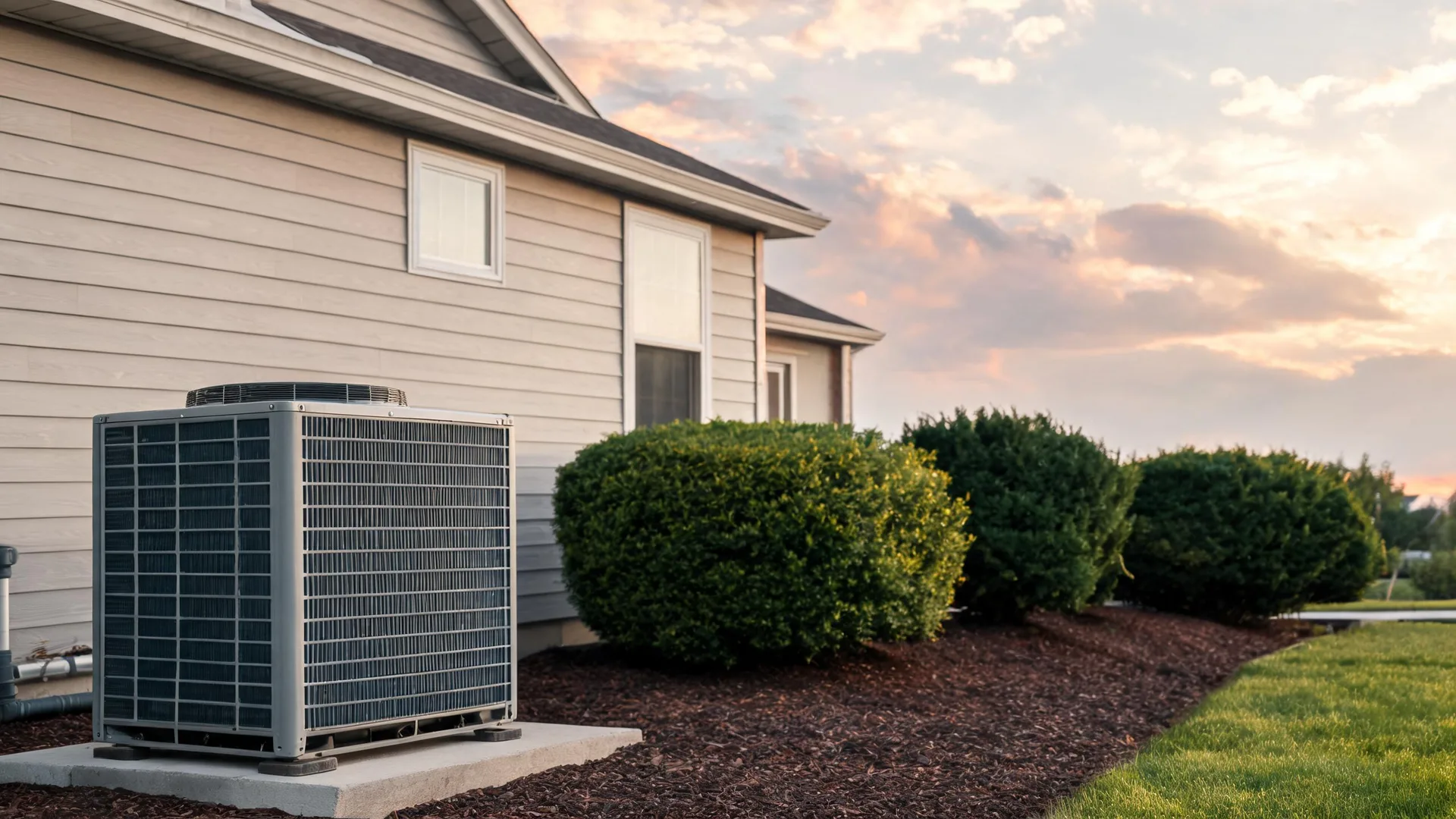
A gray heat pump outdoor unit mounted on a concrete pad next to the stone-accented exterior wall of a house.

Sized right, it runs for years. Sized wrong, it wears out trying.

A heat pump runs more hours in a year than a furnace alone ever did, because it's doing the job of both the heating system and the air conditioner, just handing off between modes as the temperature swings. That's more run time on the compressor, more cycles for the reversing valve, more hours for the outdoor fan motor. Sizing it right is what keeps all of that from wearing out early. A unit sized too big will short cycle, shutting off before it finishes a full heating or cooling run, and that's harder on the compressor than a longer steady run would be. It also won't pull enough moisture out of the air in summer, so the house can feel clammy even when the temperature reads fine. A unit sized too small will run long stretches without ever catching up, leaning hard on backup heat strips more often than it should, which costs more to run and puts hours on a part that's meant for occasional use, not daily work. Getting the size right starts with a load calculation, not a guess based on the square footage of the house or what the last system was rated for. A contractor measures the walls, the windows, the insulation, the duct layout, and works out how much heat the house actually loses in winter and gains in summer. That number, not the age or size of the old equipment, is what the new system gets matched to. A heat pump sized off that calculation runs the way it's supposed to for as many years as it's built to last.

The site work changes what the job takes

An outdoor unit needs a pad or mounting brackets, clear space around it for airflow, and a line set run to wherever the indoor air handler goes. If that path has to cross a finished wall, go through tight framing, or run further than a straightforward install allows, the labor and materials to get refrigerant line and wiring from one end to the other add to the job. Electrical work factors in too. A heat pump with backup strips draws more than many existing circuits are built for, and if the panel doesn't have room or capacity for a new dedicated circuit, that's its own piece of work before the unit ever gets set.
The equipment itself is not one price

Heat pumps are built across a range of efficiency levels, and the compressor inside them differs too. A single-stage compressor runs at one speed, on or off. A two-stage or variable-speed compressor adjusts its output to match the load, which costs more up front but runs quieter and holds steadier temperatures. Ductwork condition matters as well. Existing ducts that are undersized, leaky, or laid out for a furnace that pushed air differently than a heat pump does may need modification for the new system to deliver air the way it's designed to. None of that shows up in the price of the unit alone.

Gas heats 88% of homes in Macomb County, more than anything else by a wide margin. Electricity, propane and oil together account for the rest. A heat pump installed here usually isn't replacing a furnace outright. More often it's paired with the existing gas furnace as a dual fuel system, switching over to gas when the outdoor temperature drops low enough that the heat pump stops being the cheaper way to heat the house. The gas line, the furnace, and the venting already in place shape how a contractor ties in the new equipment. Worth asking directly whether the plan is to replace the furnace or work alongside it, since that changes what gets installed.

That electric rate is worth asking about when a contractor quotes a system, not just when the bill arrives. A two-stage or variable-speed compressor costs more up front than a single-stage unit, but it holds its output steadier instead of running flat out every time it kicks on. Ask how the efficiency rating was reached and whether it holds up over the equipment's rated life, not just on paper at install. The size of the unit matters just as much as its rating. A system sized off a real load calculation runs the way it's supposed to, and a unit running the way it's supposed to is the one that keeps that rate from piling up on every bill it sends.