





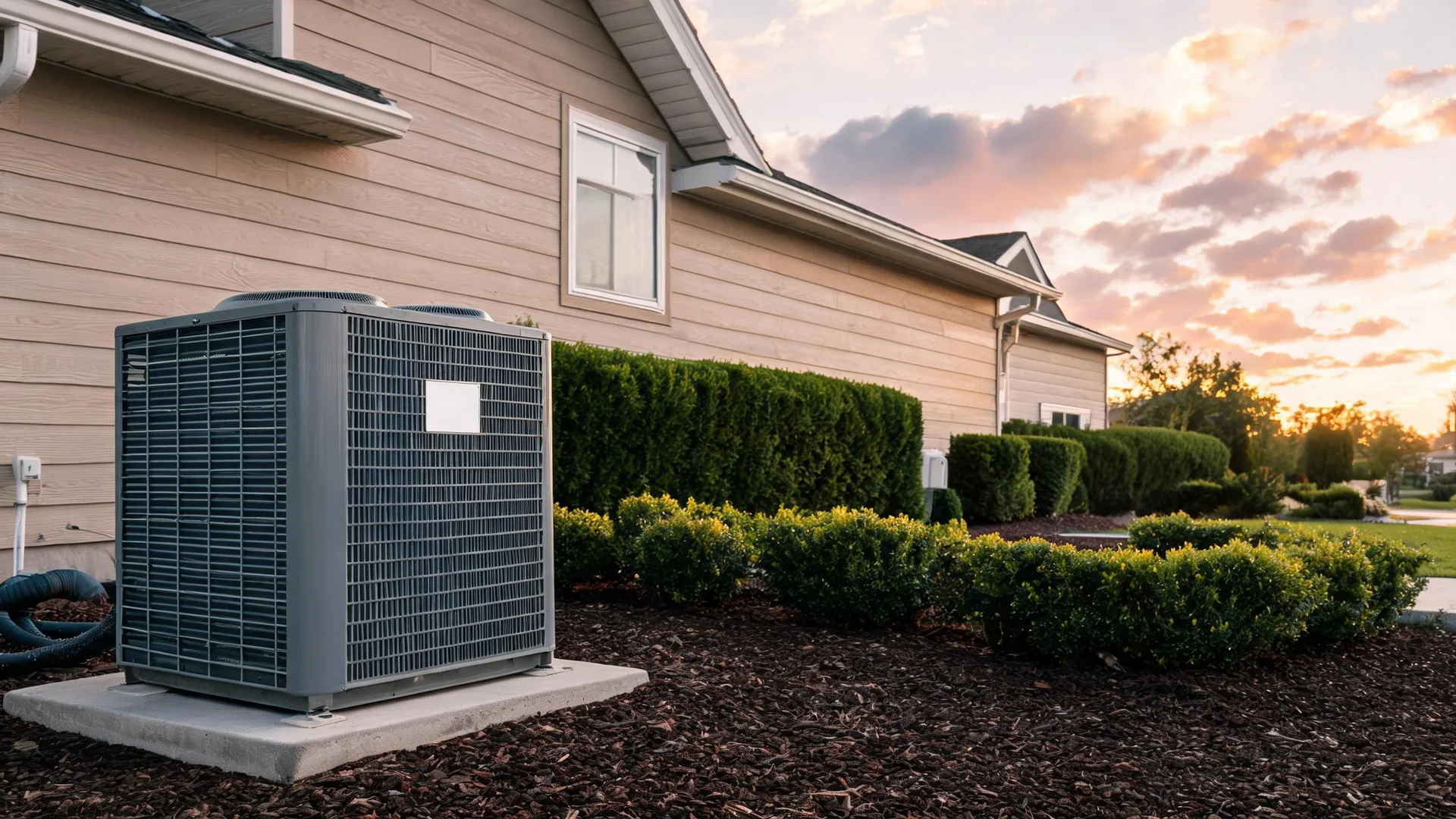
A grey outdoor HVAC unit mounted on a concrete pad beside the beige-sided exterior wall of a suburban house.

Heat Pump Installation in Hastings, MI

Tell us about the job

Takes about a minute. No obligation.

New system or replacementHeat PumpBarry County, MI
Step 1 of 2

What ZIP code is the job in?

Electricity in Barry County runs about 20.50 cents per kilowatt-hour, higher than in most US counties. A heat pump runs on electricity alone, so that rate applies to every degree it moves, heating or cooling. A unit with a stronger efficiency rating uses less power to do the same job, and at this rate the difference shows up on the bill month after month. Where power is cheap, that difference barely registers. Here it does not work that way.

8 months
October through May, your system heats
3 months
June through August, it cools
19°F
the average winter night it heats against
81°F
the average summer afternoon it cools against
Isometric illustration of a cutaway single-story house showing interior ductwork and an air handler connected by lines to an outdoor condenser unit on a pad beside the building.
Your system heats October through May and cools June through August.

NOAA nClimDiv, 1991–2020 normals

A heat pump in Barry County isn't fighting extreme heat all summer, just a dew point that averages 60°F.

A straightforward system can handle that load without needing the top efficiency tier to do it.

Eight months of heat, three of cooling: install before the one that comes first

Cooling runs June through August
Heat runs October through May
13 winter storms from 2015 to 2024

Barry County saw 36 severe weather events between 2015 and 2024, and 17 of those were damaging wind. Hail hit 4 times, tornadoes touched down twice, and winter storms, the heavy snow and ice kind, came through 13 times. An outdoor heat pump unit sits outside through all of it, so where it goes matters: clear of falling branches, away from the drip line of a roof, up on a stand if the yard floods or drifts deep. Statewide, 34% of Michigan households lost power for a day or more in 2024. A heat pump needs electricity to move heat either direction, so an outage means no heating or cooling until power is back, and that is worth planning around if backup power matters to your household.

The efficiency rating you choose is what you live with on every bill

Barry County pays more per kilowatt-hour than most places do, and a heat pump runs on nothing else. That is already settled by the time you are picking a unit. What is still open is the efficiency rating on the one you choose, and that number follows you onto every bill from here on. Worth asking whoever quotes the job to walk through it.

Find a contractor
A residential heat pump outdoor unit mounted on a concrete pad next to a house with gray vinyl siding.

An Easier Job Than Most Places Ask Of It

Barry County is zone 5A, a cool climate where heating carries the bigger share of the work. That is the opposite of a system fighting hard against summer heat for months on end. Add in the mild dew point already mentioned and you get a unit that spends most of its working hours on moderate demand, not peak strain. Less strain over the years means a repair is more often worth making instead of replacing the whole system. It does not mean skipping maintenance or buying the cheapest unit on the lot. Winter storms came through this county 13 times between 2015 and 2024, and a unit sitting outside through that needs to be built to take it. Pick for reliability over the years, not the top efficiency number.

Sizing by square footage alone gets it wrong

A heat pump has to be sized to the heat loss and heat gain of the house, not just the floor area. Two homes the same size can need different tonnage depending on insulation, window area, ceiling height, and how much air leaks out. A contractor works this out room by room, adding up walls, windows, and ductwork, not by a rule of thumb per square foot.
Oversized and undersized both cause problems

A unit that's too big cools the air fast and shuts off before it pulls moisture out, so the house feels clammy even at the right temperature. It also cycles on and off more, which wears the compressor harder over time. A unit that's too small runs constantly during the coldest and hottest stretches and still can't keep up, leaning hard on backup heat strips that cost more to run than the heat pump itself.

Whoever replaces the system still has to deal with the old outdoor unit and whatever is handling heat now. A heat pump condenser holds refrigerant, and that has to be recovered properly before the unit is disconnected, not vented. If the home is switching from a furnace, the old ductwork gets inspected before the new coil goes in, since a heat pump moves a different volume of air and leaky or undersized ducts will hold it back no matter how good the new unit is. The electrical side usually needs a look too. Heat pumps draw power differently than a gas furnace did, and the breaker or disconnect that served the old equipment may not be rated for the new one. None of this is a reason to put off replacing a system that is struggling. It just means the old equipment doesn't simply get unplugged and hauled off. It gets disconnected the right way, and whatever it was tied into gets checked before the new unit takes its place.

Gas heats more homes in Barry County than anything else, 52.9% of them. A heat pump replacing a gas furnace isn't replacing like for like, since the furnace burned fuel on site and the new system runs on electricity instead. That changes what the house needs alongside it. Ductwork sized for a furnace was built around how that furnace moved air, and a heat pump has to work through the same ducts differently. Worth having that checked before the new unit goes in, not after.