





Three lit brick homes on a tree-lined residential street photographed at dusk.

Heat Pump Installation in Grand Rapids, MI

Tell us about the job

Takes about a minute. No obligation.

New system or replacementHeat PumpKent County, MI
Step 1 of 2

What ZIP code is the job in?

Electricity in Kent County runs about 20.54 cents per kilowatt-hour, and that's higher than what most counties in the country pay. A heat pump moves heat instead of burning gas or firing up resistance coils, but it still runs on that electric rate every time it cycles on. When power costs this much, the efficiency of the unit itself stops being a spec on paper and starts showing up directly in what you pay each month. Two systems can heat and cool the same house and land on very different bills, just based on how much electricity they pull to do it.

8 months
October through May, your system heats
3 months
June through August, it cools
19°F
the average winter night it heats against
81°F
the average summer afternoon it cools against
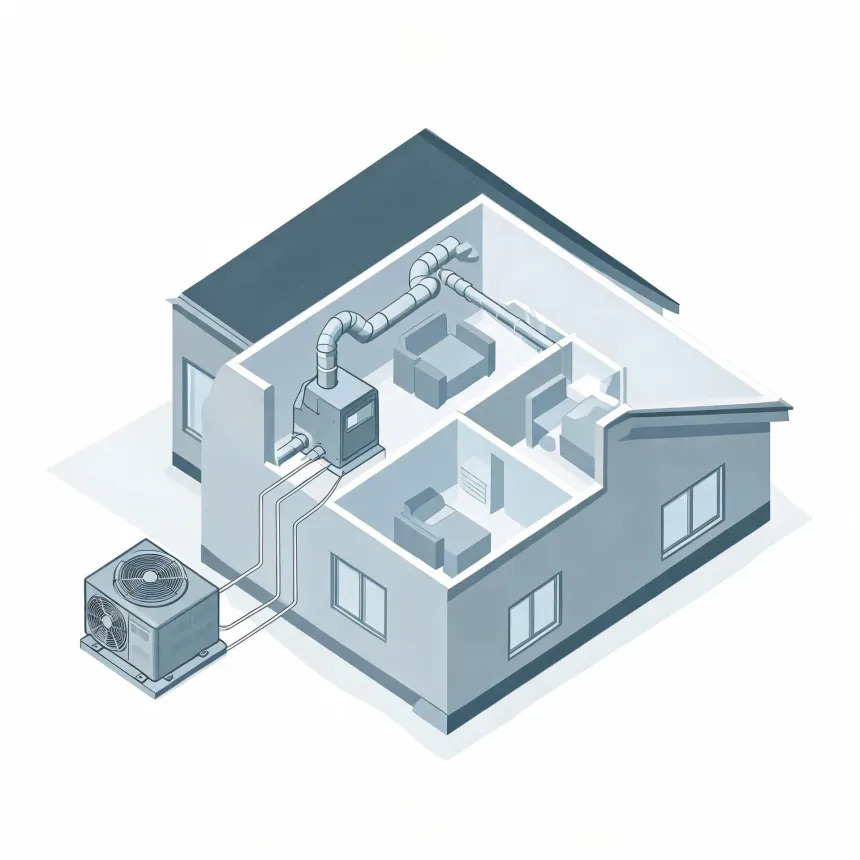
Isometric cutaway illustration of a two-room house showing an indoor air handler with ductwork connected by lines to an outdoor condenser unit on a pad.
Your system heats October through May and cools June through August.

NOAA nClimDiv, 1991–2020 normals

Grand Rapids summers top out around a 60°F dew point, lower than most of the country.

A heat pump here isn't fighting the air all season, so it doesn't need to be the strongest one on the lot.

8 tornadoes, 56 wind events: where the outdoor unit sits matters

90 severe weather events from 2015 to 2024
34% of homes statewide lost power a day or more in 2024
56 damaging wind events from 2015 to 2024
When the Power Goes, So Does the HeatKent County saw 90 severe weather events between 2015 and 2024, and over a third of Michigan homes lost power for a day or more in 2024.

Kent County falls under zone 5A in the 2021 energy code, a cool zone where the furnace or heat pump runs longer for heat than for cooling. Any split-system heat pump sold new has to clear a federal floor to be installed anywhere: at least 14.3 Btu of cooling for every watt-hour it draws, and at least 7.5 Btu of heating for every watt-hour in the colder months. That's not a local rule, it's the baseline for every unit made since the start of 2023. What it means here is that the cheapest, least efficient units on paper are already off the table before you start comparing models. On top of that floor, a federal tax credit is available for systems that go beyond it, which is worth asking about when you're pricing out options.

A higher efficiency rating earns its keep here

A unit priced a little higher but rated well above the federal floor is the one that keeps paying you back, because that electric rate doesn't let up. Ask what efficiency rating each option on your quote actually carries, not just whether it qualifies.

Find a contractor
A white mini-split heat pump outdoor unit mounted on a concrete pad beside a gray-sided house, surrounded by gravel and green shrubs.

A machine that isn't fighting Grand Rapids all year

Heating pulls more hours out of this system than cooling does, since Kent County sits in a zone where heat is the bigger job. The cooling side doesn't get pushed hard here, with air that isn't heavy to work against. That's lighter use than a lot of the country sees, year over year. Less strain means a heat pump is more likely to still be worth fixing a few years in, instead of needing to be replaced from the load. When something does go wrong on a system like this, age or a skipped filter change is the usual reason, not the climate wearing it down. That's worth knowing before you pay extra for the highest efficiency rating on the lot.

Sizing drives most of the cost

A heat pump has to be matched to the house, the duct system, and the rooms it serves, not just picked off a price list. A load calculation looks at insulation, window area, and layout to size the unit correctly. Go too big and the system short cycles, wearing out parts faster and leaving the air damp. Go too small and it runs constantly without keeping up. Either mistake costs more than the calculation does.
What's already there changes the job

If the ductwork, electrical panel, and line set are already sized right for a heat pump, installation is straightforward. If the panel needs an upgrade to handle the new load, or the ducts need sealing or resizing to move enough air, that work gets added before the unit ever turns on. A contractor who inspects all of this before quoting is pricing the actual job, not just the equipment sitting in the truck.

Taking out the old system is its own job, separate from setting the new one in place. A furnace or air handler gets disconnected from the ductwork and the gas line capped off if one was there. An old air conditioner holds refrigerant, and that has to be recovered properly rather than vented, since releasing it into the air is against the law. Whoever hauls off the equipment should be handling that recovery as part of the removal, not skipping past it. Once the old unit is out, the duct connections and electrical whip get checked before the new heat pump goes in, since those pieces often get reused. A clean removal also means a last look at the space, the pad outside and the closet or utility area inside, to confirm it's actually ready for what's going in next.

Gas heats 81.7% of homes in Kent County, the kind of share that means most houses here already have a furnace doing the heating and a separate unit outside doing the cooling. Electricity runs a distant second at 11.4%. That history matters for how a heat pump gets installed, not just how it runs once it's in. A lot of these setups can pair a heat pump with the existing ductwork, sometimes keeping the gas furnace as backup for the coldest stretches instead of ripping out a working system. Replacing an electric setup is simpler still, since the wiring and ducts are already built around an electric load. Either way, what's already in the house decides how much of this job is swapping equipment and how much is rebuilding around it.