






Three illuminated two-story brick houses on a tree-lined residential street photographed at twilight, with warm window light and landscape uplighting visible against a deep blue evening sky.

Heat Pump Installation in Dowagiac, MI

Tell us about the job

Takes about a minute. No obligation.

New system or replacementHeat PumpCass County, MI
Step 1 of 2

What ZIP code is the job in?

Michigan electricity ran 19.30 cents per kilowatthour in 2024. A heat pump that's losing capacity to a dirty coil or the wrong refrigerant charge turns more of those cents into waste, month after month. The efficiency rating on the unit you choose matters more here than it would somewhere power is cheap. Ask what HSPF2 and SEER2 the installer is quoting, and ask how that number was reached for this house, not just the equipment.

8 months
October through May, your system heats
3 months
June through August, it cools
20°F
the average winter night it heats against
81°F
the average summer afternoon it cools against
Isometric line illustration of a cutaway house showing interior rooms with furniture, a furnace or air handler with overhead ductwork, and an outdoor condenser unit connected by lines outside the wall.
Your system heats October through May and cools June through August.

NOAA nClimDiv, 1991–2020 normals

Dowagiac winters average 20°F overnight, and Cass County is zone 5A, where heating is the bigger job.

A heat pump here spends the cold months working, not the summer, so pick one built to hold up to that, not one bought for the hottest day.

Cass County sees its share of storms, so think about where the outdoor unit sits and what happens to heat in an outage

86 severe weather events from 2015 to 2024
34% of homes statewide lost power a day or more in 2024
47 damaging wind events from 2015 to 2024
Built for the house you haveHalf the homes in Cass County were built by 1973, and a heat pump has to match that house, not a new one.

Cass County falls under zone 5A, a cool, humid zone where heating carries the bigger load. Any split-system heat pump installed here, if manufactured from 2023 on, has to clear federal minimums of 14.3 SEER2 for cooling and 7.5 HSPF2 for heating. That's the floor, not a target, so a contractor quoting a system for this county should be starting above those numbers, not at them. A federal tax credit is available for qualifying heat pump installations, worth asking about before you settle on equipment.

Most of Cass County heats with gas. A heat pump here has to work alongside that, or replace it well.

Gas heats half the homes in Cass County, more than any other fuel. A heat pump replacing a furnace here is usually adding cooling and backup heat to a house set up for gas, not swapping one heat pump for another. That changes what the installer needs to plan for, from the thermostat to how the two systems hand off on the coldest days. Worth asking how they'd set that up in your house before you sign anything.

Find a contractor
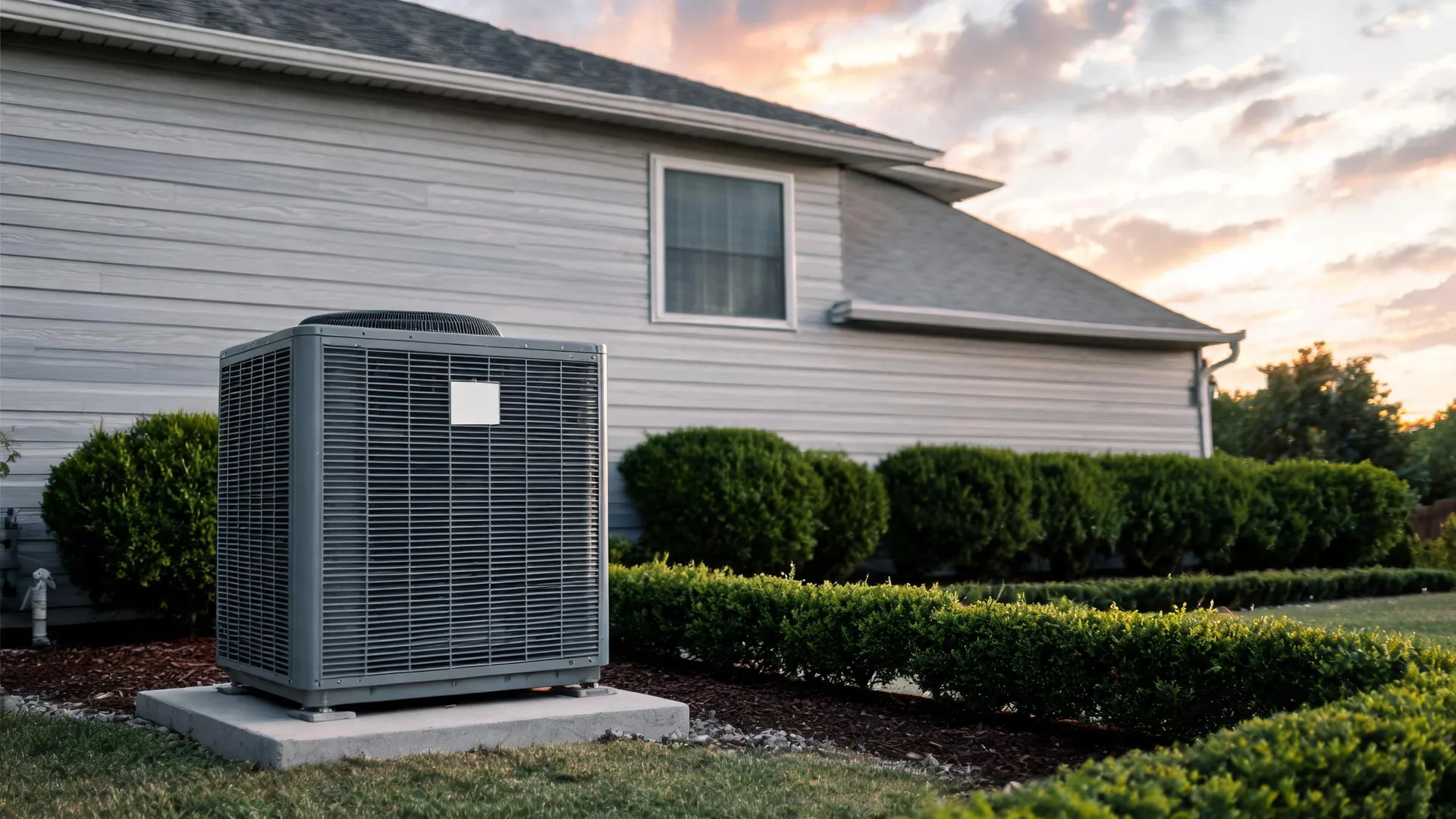
A gray heat pump condenser unit mounted on a concrete pad against the gray lap-siding exterior wall of a house.

Eight months of heat, three of cooling

Heat here runs October through May, about eight months of the year. Cooling runs three months, June through August. The heat pump spends most of its time on the harder job, not the easier one, so size and install it with that job in mind. September is the month before heat season starts here, and that is the time to get a system in. Have it done before the first cold night and you get to compare bids and ask questions, instead of taking whatever install date is open once everyone else is calling with no heat.

Ask for the load calculation, not a guess

A heat pump sized off square footage alone can end up wrong in both directions. The right size comes from a room by room load calculation that accounts for windows, insulation and layout. Ask to see it, not just the number it produced.
Ask what happens below the balance point

Every heat pump has a temperature where it can no longer keep up alone, and needs backup heat to fill the gap. Ask what that point is for the system being quoted, and what kicks in under it. That answer tells you more about comfort on the coldest nights than any spec sheet.

HSPF2 and SEER2 are ratios. They tell you how much heat or cooling a unit moves for the power it spends, so a higher number means less waste for the same comfort. That number comes from a lab test run under set conditions, not from your house. A unit with a strong rating can still underperform once it's installed. What changes the real result is the install itself. A properly sized unit, a tight refrigerant charge, ductwork that lets air move the way it should. A high rating on a unit that's oversized or poorly charged still runs up the power bill. Ask the installer how they verify charge and airflow after the unit goes in, not just which model carries the rating.

Installation day starts with the outdoor unit. The crew checks clearance around it and makes sure the pad underneath is level before anything gets set down. Next comes the indoor coil and the air handler or furnace it ties into. Refrigerant lines get run or reused depending on the job, and every joint is brazed then pressure tested before any refrigerant goes in. That test matters because a slow leak missed on day one shows up later as a system that struggles to keep up. Once the lines hold pressure, the system gets evacuated to pull out moisture and air, then charged to the weight the manufacturer specifies, not just until the gauges look close. The last part of the day is airflow and controls, setting the thermostat and checking the ductwork before running the system through a full heating and cooling cycle. A crew that skips that last run is leaving the callback for the first cold night.