Three lit brick homes on a tree-lined residential street photographed at dusk.

Furnace Repair in Greenville, MI

Tell us about the job

Takes about a minute. No obligation.

RepairFurnace or heatingMontcalm County, MI
Step 1 of 2

What ZIP code is the job in?

Montcalm County sees real storm numbers

Montcalm County recorded 36 severe weather events between 2015 and 2024, including 18 damaging wind events, 8 hail events, and 10 winter storms. That's weather that reaches equipment sitting outside or depending on power to run.

A furnace needs power to work at all

A gas furnace still needs electricity to run its blower and controls, and over a third of Michigan households went at least 24 hours without power in 2024. When the power drops in a Greenville winter, the furnace stops with it, gas or no gas.

9 months
September through May, your furnace is on duty
17°F
the average winter night it heats against
10 winter storms
in ten years, the nights a failure hurts most
Isometric grayscale illustration of a cutaway house showing an interior furnace with a tall flue pipe and ductwork running to rooms under a partially lifted roof.
Your furnace works hardest from November through March.

NOAA nClimDiv, 1991–2020 normals

Most furnace failures start with the igniter or the flame sensor, not the gas line.

Those parts wear out from normal cycling, so a furnace that ran fine last winter can still fail this one.

Nine months of heat a year wears a furnace down faster

Heat runs September through May
Winter nights average 17°F
Climate zone 5A
The first cold snap in September is when weak parts failFurnace season here runs from September through May, and August is the last easy month to find trouble before it starts.

Nine months of running wears parts down, and that's worth knowing, but it doesn't tell you what's wrong with yours right now. A furnace that short-cycles, blows cold air, or won't light at all needs someone to actually look at it. Guessing at the part only costs you another service call when the real problem shows up a week later. A tech who checks the igniter, the flame sensor, and the pressure switch in one visit finds the actual cause instead of replacing whatever's easiest to reach. With winter here lasting from September to May, a repair that's done right the first time is the one that gets you through it.

If this winter's storms reached the furnace, get it looked at

Wind, hail and snow have already hit this county dozens of times over the past ten years, and a furnace sitting through that kind of weather doesn't always show the damage right away. If yours has been through a bad storm and anything about it seems off, have it checked before the next cold snap finds the problem for you.

Find a contractor
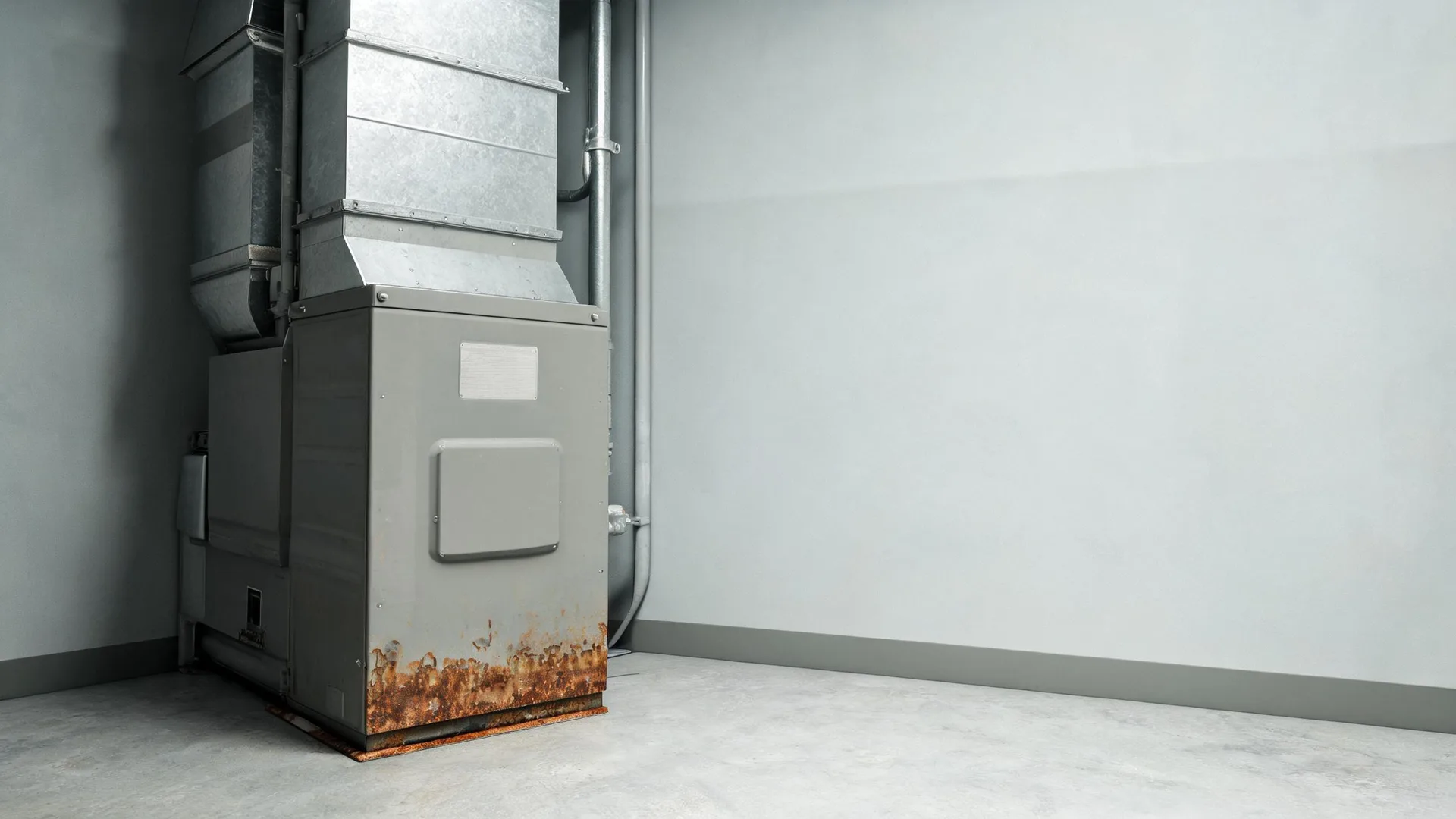
A gas furnace with attached ductwork, gas piping, and condensate lines installed in a concrete-block basement.

Some problems don't wait for you to notice them

A furnace that's struggling doesn't fix itself by staying on. A cracked heat exchanger gets worse with every cycle of heating up and cooling down, since that's what opens the crack wider. A clogged burner keeps burning dirty until soot chokes it further. A failing igniter has to work harder to light the burners each time it's asked, which shortens whatever life it has left. Even something as simple as a dirty filter forces the blower motor to strain against the blocked airflow, and a strained motor runs hotter than it should. None of these fix themselves by running longer. They fail a little more each time the furnace cycles on, until the part that was struggling is the part that quits.

Check the thermostat and the filter first

Make sure the thermostat is set to heat and the temperature is actually set above room temperature, since a bumped setting is an easy thing to miss. Pull the filter and hold it up to a light. If you can't see light through it, that's enough to choke airflow and cause the furnace to overheat and shut itself off partway through a cycle.

Look at the switches before you call

Check that the furnace's power switch, often a light switch on or near the unit, hasn't been bumped off. Check the breaker too. If the furnace has a standing pilot, see if it's lit, and if it uses an igniter, listen for clicking at startup. A furnace that tries to start but won't stay lit is telling you something different than one that does nothing at all.

An unfinished basement featuring exposed ceiling joists, a metal HVAC unit with round ductwork, a hanging light bulb, and scattered boxes and debris along the left wall.

A new furnace would cut about $160 a year off heating for a typical Montcalm County home.

  • A new high-efficiency furnace$630 a year
  • An older furnace$790 a year

Estimates for a typical Montcalm County home, compared with an older unit built to the previous federal minimum, from EIA household energy data, Michigan fuel prices and NOAA climate normals. Your home will differ.

Repair makes sense when one part has failed and the heat exchanger is sound.

Replacement makes sense when the heat exchanger is cracked or the furnace keeps needing parts.

A diagnostic visit starts before the panels come off. A tech will ask what the furnace was doing: trying to light and failing, lighting and shutting off, running but not heating, or just sitting dead. That changes where they look first. From there they pull the panel and watch it run through a cycle, checking the igniter glows or the pilot stays lit, the flame sensor reads properly once the burners light, and the pressure switch closes the way it should as the inducer motor spins up. They'll check the flame itself, since a steady blue flame means clean combustion and a yellow or flickering one points to a dirty burner or a venting problem. Airflow gets checked too, because a return that isn't pulling enough air can shut a furnace down even when every electrical part is fine. By the end they can usually point to the one part that failed rather than guessing at a handful of them.