




Three illuminated two-story brick houses on a tree-lined residential street photographed at twilight, with warm window light and landscape uplighting visible against a deep blue evening sky.

Furnace Maintenance in Lansing, MI

Tell us about the job

Takes about a minute. No obligation.

Tune-up, service, or cleaningFurnace or heatingIngham County, MI
Step 1 of 2

What ZIP code is the job in?

Ingham County saw 44 severe weather events between 2015 and 2024. Most of that was wind, with 21 damaging wind events and a tornado on top of it, plus 10 hail events and 12 winter storms with heavy snow and ice. Wind and hail both reach the outdoor parts of a heating and cooling system, and a winter storm can knock out power along with it. Across Michigan, 34% of households went at least 24 hours without power in 2024. A furnace that hasn't been checked since the last storm season may be carrying damage you can't see from the kitchen window.

Half the homes in Ingham County were built in 1971 or earlier.

A furnace that old has had a lot of winters to wear on it, and a yearly check is how you find out before it fails on you.

Eight months of heat a year wears a furnace down faster

Heat runs October through May
Winter nights average 19°F
Climate zone 5A
Most of Ingham County heats with gas68.5% of homes here run on utility gas, and a gas furnace has a burner and venting that need yearly checking, not just a filter swap.

Furnaces here start running in October and don't let up until May. That's eight months of the year this machine has to work. September is the month to get it checked, before it has to carry the first cold snap. A furnace that's sat idle since spring can have a cracked heat exchanger, a dirty flame sensor, or a clogged filter, and none of that shows up until the first night it drops below freezing and the system has to prove itself. By January, overnight lows here average 19 degrees. That's not the time to find out something was wrong.

Get the furnace checked before the next storm finds its weak spot

A tune-up before winter is when a contractor can catch what the last storm season left behind, a dented coil, a loose connection outside, anything that could keep the furnace from carrying the house through an outage. That matters more here than in most places, and it's easier to deal with now than after the power's already out.

Find a contractor
A man in a dark shirt and brown work pants, seen from behind, carries a worn canvas tool bag up porch steps toward a dark front door, with a potted shrub to the right.
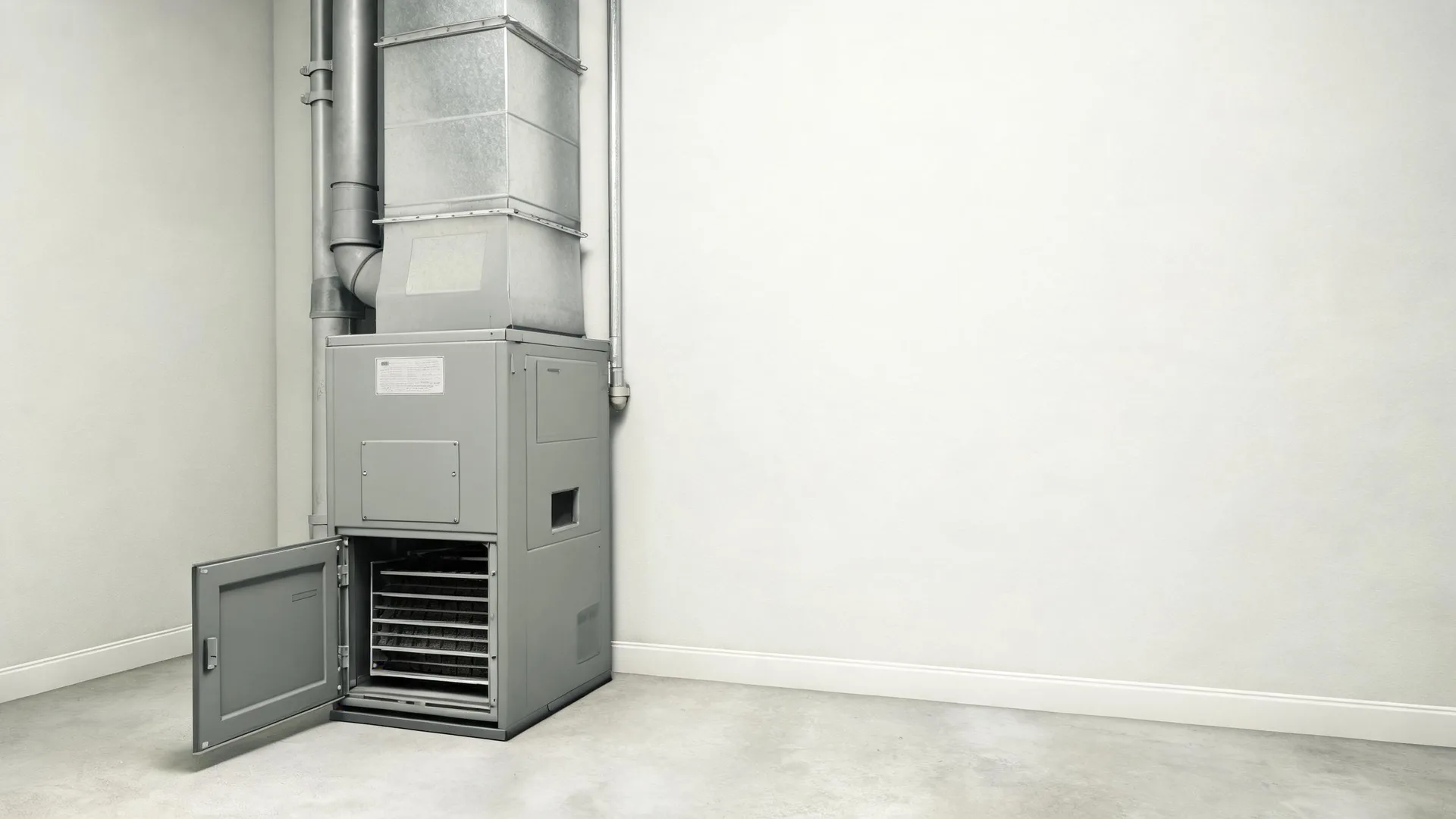
A gray residential gas furnace installed in an unfinished basement, connected to sheet-metal ductwork and PVC pipes.

Eight months of running leaves little time to get inside it

Eight months of running time doesn't leave this furnace much rest between seasons. What's left of that rest is when a tune-up has to happen, before the system is carrying the house through a cold night. A technician working on it before the running starts can catch a loose connection or a worn part while nothing depends on it yet. Wait until the cold sets in and the same check happens with the furnace already working to keep the house warm.

A dirty filter makes the whole system work harder

Air has to pass through that filter every time the blower runs. Once it's clogged with dust, the furnace has to pull harder to move the same air, and that strain lands on the blower motor. A restricted filter can also let the heat exchanger run hotter than it should, which shortens its life.
The flame sensor and burner need eyes on them every year

A furnace burns fuel to make heat, and that process leaves residue on the flame sensor and burner over time. A sensor coated in buildup can't tell the system the flame is still lit, so the furnace shuts itself down as a safety measure. Cleaning that part is routine work, but it only happens if someone checks it.

A quick tune-up means someone swaps the filter, glances at the thermostat, and calls it done. A thorough one means the furnace gets taken apart enough to see what the filter swap never shows. The burner assembly comes out so the flame can be looked at directly, not guessed at. The flame sensor gets cleaned, not just checked. The heat exchanger gets inspected for cracks, because a cracked one can leak exhaust into the air the blower moves through the house. The igniter gets tested under load, since it can glow and still fail to light the burner reliably. Gas pressure gets measured at the valve instead of assumed. The blower wheel comes off its housing to clear dust that builds up where the filter can't reach. Someone who skips all that and still calls it a tune-up has only changed the one part you could have changed yourself.

A tune-up has a sequence to it, and skipping steps is how problems get missed. It starts outside the cabinet, checking the venting for blockage or damage, since exhaust has to have a clear path out. Inside, the wiring gets checked at every connection, because a loose wire can cause the furnace to cycle oddly or not start at all. The thermostat gets tested against the furnace's actual response, not just its display. Safety switches get checked too, the ones that shut the furnace down if the blower fails or the system overheats. Those switches sit unused most of the year, and the only way to know one still works is to test it on purpose. A furnace can run fine for a while with one of them dead and give no sign until the day it matters.