



A gray forced-air furnace with sheet-metal ductwork stands in an unfinished basement with exposed wooden joists, concrete walls, and a hanging incandescent bulb.

Furnace Maintenance in Greenville, MI

Tell us about the job

Takes about a minute. No obligation.

Tune-up, service, or cleaningFurnace or heatingMontcalm County, MI
Step 1 of 2

What ZIP code is the job in?

Montcalm County had 36 severe weather events between 2015 and 2024. Eighteen of those were damaging wind, and the county saw 10 winter storms in that stretch too, on top of 8 hail events. None of that is about the furnace directly, but it adds up to a lot of chances for the power to go out, and almost a third of Michigan households went at least a full day without power in 2024. A furnace that won't start when the power comes back, or that already had a weak part before the outage, turns a bad storm into a cold house. Checking it now costs nothing compared to finding out during the next one.

Furnaces in Montcalm County run from September through May.

Nine months of work a year wears parts down faster, and a tune-up catches that before the cold does.

Almost half this county burns gas to stay warm, and a flame needs more checks than a filter

49.1% of homes heat with gas
Climate zone 5A
Heat runs September through May

Heat goes on here in September. That first month puts the furnace under full load right away, no easing into it. If a part is going to fail, it tends to show up once the system is running hard, not while it sits idle. Booking the check in August means any weak part gets found while the weather is still mild enough that a short wait for parts or a visit doesn't leave anyone cold. Wait until September and the furnace is already carrying the season's first real demand before anyone's looked at it.

Have the furnace checked before the next outage tests it

Winter storms are what knock out power here, and a furnace that won't restart after an outage leaves the house cold until someone looks at it. A tune-up checks the parts that make a furnace start reliably, before the next outage decides to test that for you.

Find a contractor
A man in a cap, dark T-shirt and tan work pants carries a canvas tool bag up wooden porch steps toward a gray front door, with a potted shrub beside the entry.
A gray residential gas furnace installed in an unfinished basement, surrounded by ductwork, a metal flue pipe, and a gas supply line.

Nine months of work a year

Nine months of runtime means nine months of the blower cycling on and off, the igniter firing over and over, the same switches opening and closing. That kind of use catches up with parts long before anyone notices a chill in the house. A tune-up now checks what that wear has done before the furnace has to prove it on a cold morning.

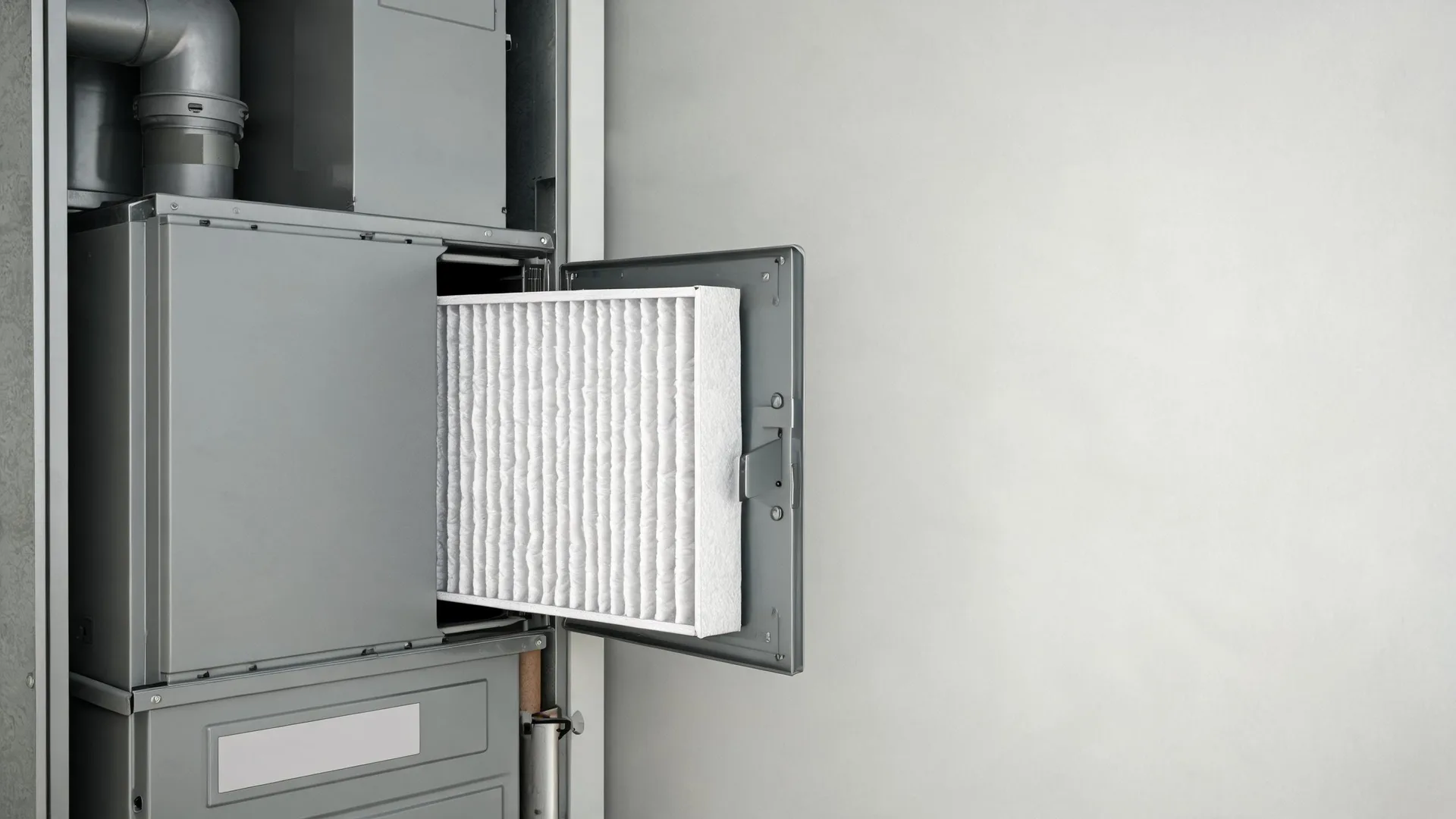
Change the filter

A dirty filter chokes airflow across the heat exchanger, and that makes the furnace run longer to reach the same temperature. Check it every month during the heating season and swap it when it looks gray or clogged. Hold it up to a light. If light doesn't pass through easily, it's done.
Know what to leave alone

Don't open the burner compartment or touch the gas valve. Don't oil the blower motor unless the manufacturer says it needs it, most newer motors are sealed and don't. If the furnace smells like gas, don't flip any switches, leave the house and call the gas company from outside. Clearing vents and keeping furniture away from the return air grille is safe. Anything past that is a job for someone who works on these for a living.

A furnace doesn't have coils or a drain, that's the air conditioner's job when it shares the same blower and ductwork. What a furnace has is a filter, and a heat exchanger behind it that depends on the filter doing its work. Airflow across that exchanger keeps it from overheating. Block it with a dirty filter and the metal runs hotter than it should, cycling the furnace off on its high limit switch before the house is warm. Over time that heat stress is what cracks an exchanger, and a cracked one is a safety problem, not just a repair. The filter is the one part of this system a homeowner should already be checking without being told.

A tune-up starts before the burners ever light. A tech pulls the panel and looks at the heat exchanger with a flashlight or a camera, checking for cracks or rust-through, since that's the part separating combustion gas from the air moving through the house. The flame sensor gets cleaned, because a coated sensor is one of the most common reasons a furnace fires for a few seconds and shuts back off. The igniter gets checked too, for cracks or for resistance that's drifted out of range. Burners get cleaned of dust and lint so the flame burns even across each one instead of guttering on one side. The blower wheel gets inspected for dirt buildup, since a dirty wheel moves less air even at the same speed. Belts, if the furnace has one, get checked for wear, and motors get checked for the grinding or whining that means a bearing is going. Gas pressure gets measured and adjusted at the valve, because too much or too little changes how clean the furnace burns. Electrical connections get tightened, since a loose wire at a high-use terminal is what eventually burns a connector or trips a safety switch. Every safety switch, the high limit, the pressure switch, the door switch, gets tested to confirm it shuts the furnace down when it's supposed to, not just that it's present. None of this is guesswork. Each check has a pass or fail, and a tech who does this right tells you which parts passed and which ones are close to the edge.