A row of illuminated two-story brick houses with front porches and mature trees photographed at twilight.

Furnace Installation in Marquette, MI

Tell us about the job

Takes about a minute. No obligation.

New system or replacementFurnace or heatingMarquette County, MI
Step 1 of 2

What ZIP code is the job in?

Bigger isn't better

A furnace that's too big for the house turns on, heats the air fast, and shuts off again before it ever warms the walls or the floors or anything sitting in the rooms. That short cycling wears out the ignition system and the blower sooner than they should quit. The house still ends up uneven, warm in one room and cold in the next.


The size comes from a room by room load calculation

A contractor works out the right size by measuring the house itself. Square footage, ceiling height, how many windows and what they face, how much insulation is in the attic and walls. That's what decides the output the new furnace needs, not the size of the one coming out. An old furnace may have been oversized or undersized from the day it went in.

10 months
September through June, your furnace is on duty
9°F
the average winter night it heats against
62%
of homes here heat with gas, so most furnaces here burn gas
80% AFUE
the federal minimum any new unit must meet
Isometric cutaway illustration of a single-story house showing interior rooms with a dark furnace unit, connected ductwork, a vertical flue pipe through the roof, and simple furniture, on a white background.
Your furnace works hardest from November through April.

NOAA nClimDiv, 1991–2020 normals

Furnaces in Marquette County run about ten months a year, September through June.

A new furnace here needs to be sized for nights that average 9°F, not for mild days.

Ten months of heat means almost no window to install without one running

Heat runs September through June
Winter nights average 9°F
Climate zone 7
Gas here runs $10.21 per million BtuThat's what Michigan homes paid on average in 2024, and Marquette burns a lot of it

Most houses in Marquette County heat with gas, 61.9 percent of them. Propane covers another 17.4 percent, and that number is higher out past the gas lines, where the county runs to small towns and open country. Electric heat sits at 13.4 percent. If your old furnace burned gas or propane, putting in the same fuel again is usually the straightforward path, since the line or the tank is already there. Switching fuels means new venting, maybe a new gas line or a new tank, and that's a bigger job than swapping one furnace for another.

Half these homes were built in 1971 or earlier. Size the furnace for what's there now.

Half the homes in Marquette County were built in 1971 or later, half before that. An older house may have had insulation added, windows replaced, or an addition built on since the furnace was last sized. A load calculation looks at the house as it stands now, not as it was built, so the new furnace gets sized for what's actually there.

Find a contractor
A gray high-efficiency gas furnace installed in an unfinished basement, surrounded by gas lines, a condensate drain, and sheet-metal ductwork.

The price lives in what connects to it, not the box itself

What a furnace costs to install comes down to more than the unit itself. The size matters most, and size is driven by the load calculation, not by preference. A bigger cabinet needs a bigger vent pipe, sometimes a different venting material altogether, and if the existing vent can't be reused the whole run has to be replaced. The ductwork already in the house plays into it too. If the trunk lines and branches were sized for the old furnace's airflow, a new furnace with a different blower output may need modified ducts to move air the way it's supposed to, and that's labor beyond the furnace swap. Gas line size matters as well. A furnace with higher input needs a gas line sized to deliver that, and if the existing line is undersized for the new unit, that's another line to run. The flue and combustion air intake have to meet code for whatever furnace goes in, and older installations sometimes weren't set up for a high-efficiency unit's condensate drain or PVC venting, so that gets added. None of this shows up until someone's actually in the house looking at what's there and what the new equipment needs to connect to.

The old furnace gets disconnected and hauled out

The gas line gets capped or reconnected to the new unit, the old vent connector comes down, and the furnace itself gets broken down enough to carry out. Most of what's inside, the heat exchanger, the burners, the blower, is steel and it gets recycled rather than landfilled. None of that old equipment carries over into the new setup, not the thermostat wiring, not the duct connections at the plenum. Those get rebuilt to fit whatever the new furnace needs.

The venting rarely comes over as is

A new furnace, especially a high-efficiency one, almost always vents differently than what it's replacing. The old metal flue may no longer be needed at all, and if it ran up through a chimney shared with a water heater, that water heater may need its own venting worked out once the furnace stops using the same path. Nobody knows what that looks like until the old system is actually disconnected and the chimney or flue is inspected on its own.

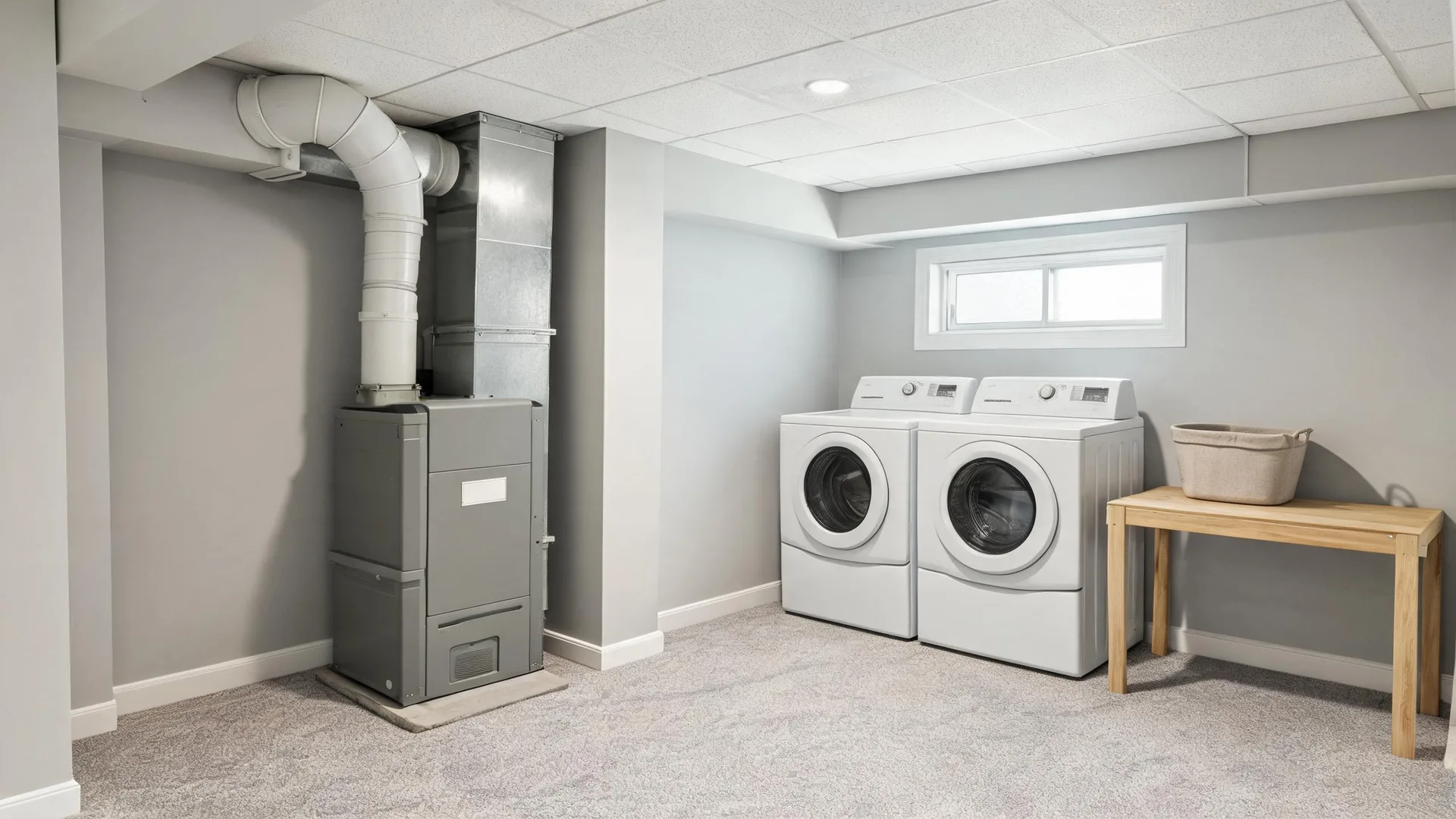
An empty unfinished basement containing a forced-air furnace with overhead ductwork, exposed ceiling joists, and a single hanging light bulb.

A high-efficiency gas furnace would save about $170 a year to run in Marquette County compared with a gas furnace.

  • A high-efficiency gas furnace$810 a year
  • A gas furnace$980 a year

Estimates for a typical Marquette County home, from EIA household energy data, Michigan fuel prices and NOAA climate normals. Your home will differ.

Install day starts with the old furnace already disconnected and the site cleared, so the work that day is building the new one into place. The furnace gets set in position, leveled, and connected to the plenum, the gas line, the vent, and the electrical. Each one is tested on its own before the whole system runs together. The gas connection gets checked for leaks. The vent run gets checked for the right pitch and clearances. Once the furnace fires, a tech checks the temperature rise across the heat exchanger, since too high or too low means something upstream or downstream isn't right. The blower speed gets set to match the ductwork it's feeding. Before anyone leaves, the thermostat gets wired in and tested, and the system runs a full cycle to make sure it shuts off and restarts the way it should.