Storms come through here often
Jackson County saw 48 severe weather events between 2015 and 2024, including damaging wind 31 times, 13 winter storms, and 3 tornadoes. That's a steady pattern, not a one-off year.
Takes about a minute. No obligation.
Jackson County saw 48 severe weather events between 2015 and 2024, including damaging wind 31 times, 13 winter storms, and 3 tornadoes. That's a steady pattern, not a one-off year.
More than a third of Michigan households went at least 24 hours without power in 2024. A furnace needs electricity to run even when the fuel is gas, so an outage can mean a cold house no matter what powers the heat itself.
NOAA nClimDiv, 1991–2020 normals
Gas heats 71.4% of homes in Jackson County, more than every other fuel combined.
A gas furnace is the system most installers here know best, down to the vent and the gas line.


Jackson County falls under zone 5A in the 2021 energy code, a cool zone where the furnace carries more of the load than the air conditioner does. Any furnace installed here has to meet the federal minimum for that climate: at least 80 percent of the gas it burns turned into heat over the winter. That rule applies to any unit built from November 19, 2015 on, so it already covers what's sold today. It tightens further for furnaces built on or after December 18, 2028, up to 95 percent. A homeowner replacing a furnace now is choosing from the current standard, not the one coming after it.
A new furnace still needs electricity to fire up and run the blower, so where the outdoor unit sits and what happens when the grid drops both matter here. Ask the installer about surge protection and where the unit is placed, away from falling branches and plowed snow. If backup power matters to you, this is the time to bring it up, before the furnace is in and the decision is harder to undo.
Find a contractor
Eight months of heat a year means the furnace is the machine working hardest in the house. Parts that fire the burner and move the air are doing it October through May, not just on the coldest days. A furnace sized and installed right for that load holds up. One that's oversized or undersized for the house runs in a way that wears it down faster, especially with this much use. When you're comparing bids, the one with the lower price isn't necessarily the one built for eight months of work a year.
A furnace is sized by working out how much heat the house actually loses through its walls, windows, ceiling, and floor, room by room, not by matching the old unit or guessing from square footage. The calculation accounts for insulation, window area, and how the rooms connect to each other. Two houses the same size can need different furnaces depending on what the walls and windows are doing.
A furnace too big for the house heats the space quickly, shuts off, and fires up again soon after, so the burner and igniter cycle far more than they're built for and the air feels uneven room to room. A furnace too small runs long stretches without ever quite catching up, pushing the blower and burner to work past what they're rated for. Either way the furnace sized wrong is the one that fails early, not the one that simply gets old.
Estimates for a typical Jackson County home, from EIA household energy data, Michigan fuel prices and NOAA climate normals. Your home will differ.
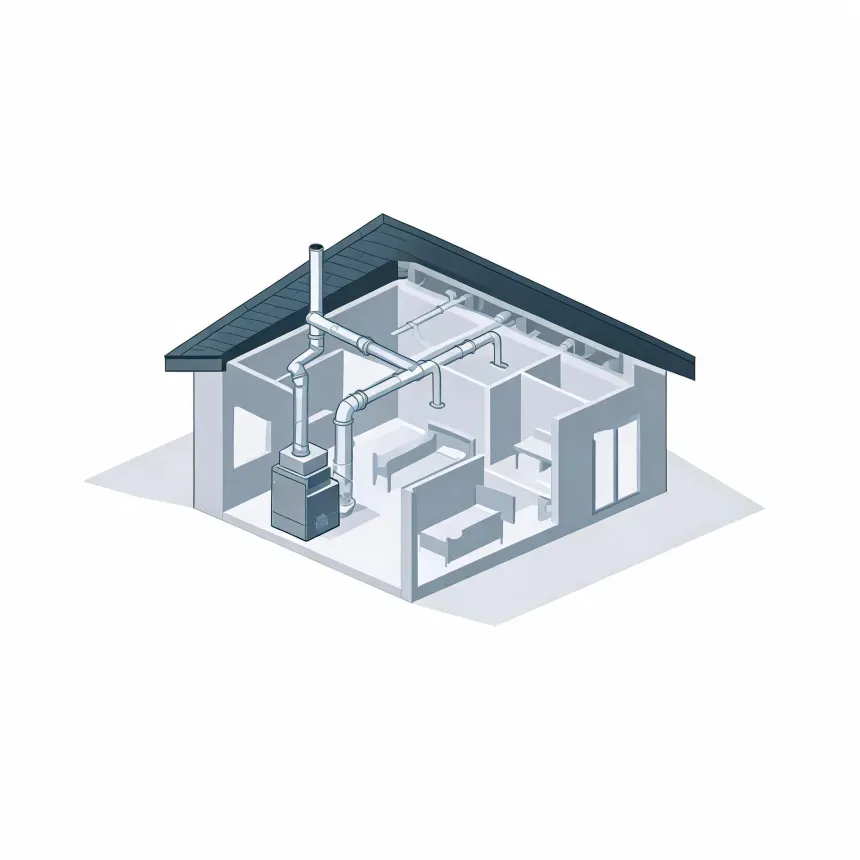
Installation starts with the old furnace coming out, along with the vent pipe and gas line connections that served it. The installer checks the gas line, the ductwork, and the electrical connection to the furnace before setting the new one in place, since all three have to match what the new unit needs. Ductwork gets connected, the gas line gets hooked up and tested for leaks, and the vent pipe is set to carry exhaust outside the way it's supposed to. Once it's wired in, the installer fires it up, checks the temperature rise through the plenum, and makes sure the blower is moving the right amount of air. The last step is checking the system for carbon monoxide and confirming the thermostat is calling for heat and getting it. A furnace put in wrong fails in ways that show up months later, not on install day, which is why each of these gets checked before the installer leaves.